


Hyaluronic Acid Knee Injections (Viscosupplementation): A Patient’s Guide
Written by Dr Gerard Ee
If your knee feels stiff, dry, and creaky, or if pain builds up the longer you stay on your feet, you may have thought of getting a hyaluronic acid knee injection. Sometimes called a knee gel injection or viscosupplementation, the hyaluronic acid knee injection is one of the longest-established non-surgical injection options for knee osteoarthritis.

This patient’s guide explains what hyaluronic acid is, how viscosupplementation works, what results are realistic, and who tends to benefit most from it with clinical perspective from Dr Gerard Ee at The Clifford Clinic in Singapore.
What Is Hyaluronic Acid?
Hyaluronic acid (HA) is not a foreign substance. It occurs naturally in your body, including inside your knee joint where it is a key component of synovial fluid. Synovial fluid is the thick, slippery fluid that fills the joint space.
Healthy synovial fluid does two important jobs. It acts as a lubricant that allows the cartilage surfaces of the joint to glide smoothly against each other, in addition to acting as a shock absorber that helps to cushion the load that passes through the knee with every step.
In osteoarthritis, the quality and concentration of hyaluronic acid in the joint fluid tends to decline. The fluid becomes thinner and less effective. The knee loses some of its natural lubrication and cushioning, which can contribute to friction, stiffness and pain.
What Is Viscosupplementation?
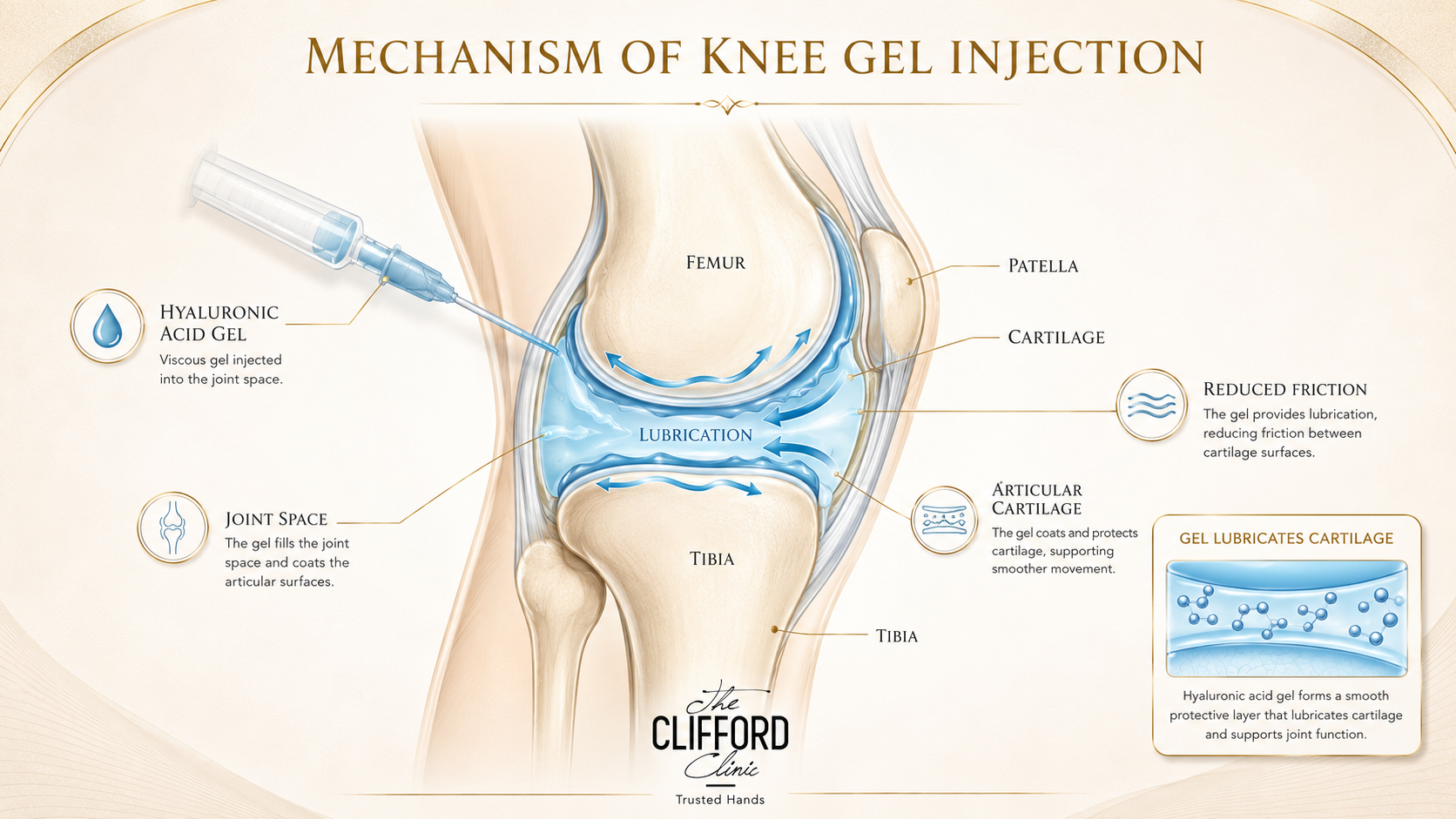
Viscosupplementation is the medical term for injecting hyaluronic acid into the knee joint to supplement the natural synovial fluid. The goal of viscosupplementation is to top up the viscosity of the fluid inside the joint to improve its lubricating and cushioning quality.
The injected HA is a gel-like preparation. Once delivered into the joint space, it restore somes of the lubricating and shock-absorbing properties that osteoarthritis has eroded, so that movement feels smoother and more comfortable.
How Hyaluronic Acid Injections Are Thought to Work
Viscosupplementation is generally described as working in a few connected ways:
- Improved lubrication. Adding HA aims to make the joint fluid more slippery, reducing friction as the knee bends and straightens.
- Better shock absorption. A more viscous fluid can help cushion the joint against impact loading.
- A calmer joint environment. Some research suggests HA may have a mild effect on inflammation within the joint and may support the cells that produce the body’s own synovial fluid.
Osteoarthritis makes a knee movement feel dry and grinding. Viscosupplementation aims to make it feel better lubricated and more comfortable to move.

Single-Injection and Multi-Injection Courses
Hyaluronic acid is available in different formulations. Some are given as a single injection, while others are delivered as a course of injections spaced a week or so apart. Different HA products also vary in molecular weight and how they are manufactured.
Neither format is automatically better. What you choose depends on the specific product, your knee, and your doctor’s assessment. The number of injections you receive depends on the treatment plan implemented by your doctor during consultation.
What Results Are Realistic?
Hyaluronic acid injections can provide meaningful relief for some patients with mild to moderate knee osteoarthritis, easing pain and making everyday movement more comfortable, often for several months.
However, major guidelines differ in how strongly they recommend viscosupplementation, and clinical trials show a range of outcomes. Some patients respond well while others notice only modest change. HA does not regrow cartilage and does not reverse arthritis. It is a treatment aimed at symptom relief and improved function, not a structural cure.
Relief is also not permanent. Because osteoarthritis is a progressive condition, the benefit of an HA course tends to wear off over time, and repeat treatment may be considered down the line. Used with realistic expectations, viscosupplementation can still be a valuable, low-disruption option.
Who Benefits Most from Hyaluronic Acid Injections?
Viscosupplementation suit patients who:
- Have mild to moderate knee osteoarthritis, rather than end-stage disease.
- Describe their knee as stiff, dry or grinding, with pain that worsens with activity.
- Want a non-surgical option and prefer to delay or avoid knee replacement.
- Have not had adequate relief from physiotherapy, weight management or simple pain measures alone.
Getting a proper diagnosis for the cause of the knee pain is important as HA injections are not recommended for treating knee pain is actually caused by mechanical problems such as a locking meniscus tear, or by ligament instability. HA injections are also generally less effective in advanced arthritis.
The Procedure and Aftercare
A hyaluronic acid knee injection is a quick, in-clinic procedure performed using sterile technique. The skin is cleaned, the knee is positioned for safe access, and the gel is injected into the joint space with imaging guidance used where it improves accuracy. Most patients describe brief pressure or stinging.
After the injection, it is common to feel mild fullness or soreness in the knee for a day or two. Light daily activity is usually fine straight away, while high-impact loading is typically eased back briefly. Pairing the treatment with strengthening and sensible load management is recommended as it gives the best long-term result.
Expert Opinion: The Clifford Clinic’s Approach to Viscosupplementation
At The Clifford Clinic, hyaluronic acid is viewed as a useful tool when it is used to treat mild to moderate knee osteoarthritis . Dr Gerard Ee and the team take a personalised, stepwise approach to ensure that treatments are tailored to suit each patient. Viscosupplementation is considered when the dominant problem is the osteoarthritis, indicated by a pattern of stiff, poorly lubricated joints. For these cases, improving the quality of the joint fluid is most likely to translate into relief.
The clinic places strong emphasis on realistic expectations. Patients are told directly that HA is a symptom-management treatment, not a cure, that responses vary, and that HA may need to be topped up over time to maintain the benefit.
Equally important is accurate diagnosis before treatment. Knee pain can come from the joint surface, the meniscus, the tendons or even a referred source. Because if this, the clinic assesses the true pain generator first, then decides whether viscosupplementation, another injection type, or a different approach altogether is the most logical next step. The aim throughout is to help patients stay active and, where possible, delay the need for surgery.
Frequently Asked Questions
Is a hyaluronic acid knee injection the same as a knee gel injection? Yes. Knee gel injection is the common name for hyaluronic acid viscosupplementation due to the HA preparation having a gel-like consistency.
How long does relief from hyaluronic acid last? Many patients experience relief lasting several months, though this varies from patient to patient. Because osteoarthritis is progressive, the effect generally fades over time and repeat treatment may be required.
Is hyaluronic acid better than a steroid injection? They do different jobs. Steroid injections act quickly to settle inflammation and acute flares but are intended for short-term use, while HA aims to improve joint lubrication with a slower, more sustained effect. The right option depends on your diagnosis and severity of knee osteoarthritis.
Will I need more than one injection? It depends on the HA product chosen. Some are single-injection treatments while others are given as a short course. Your doctor will explain the treatment plan at consultation.
Can hyaluronic acid injections cure my knee osteoarthritis? No. HA does not reverse arthritis or regrow cartilage. It is a treatment for symptom relief and improved function, best used alongside strengthening and load management.
Related Reading
Other guides in The Clifford Clinic knee injection series:
Clinic treatment pages:
Speak to The Clifford Clinic About Your Knee Pain
If your knee feels stiff and dry and you want to know whether viscosupplementation is a reasonable option, the right starting point is a proper assessment.
Knee assessments and injections at The Clifford Clinic are carried out by an experienced medical team that includes sports physicians and orthopaedic surgeons supported by an MOH-approved day surgery facility. Knee joint injections may also be claimable through Medisave and insurance and the clinic can advise on your eligibility and coverage at consultation.
The Clifford Clinic 50 Raffles Place, #01-01 Singapore Land Tower, Singapore 048623 (Exit B, Raffles Place MRT) Phone: (65) 6532 2400 | WhatsApp: (65) 8318 6332
About Dr Gerard Ee

Dr Gerard Ee is a physician at The Clifford Clinic whose main specialty is dermatology and aesthetic medicine, and who is also trained in orthopaedic surgery, with a substantial peer-reviewed research record in orthopaedics. His published work spans knee surgery, including studies on total knee arthroplasty and joint line restoration in journals such as The Knee and the Journal of Bone and Joint Surgery (British), as well as shoulder, spine and bone-healing research in titles including Knee Surgery, Sports Traumatology, Arthroscopy, Clinical Orthopaedics and Related Research and the Journal of Orthopaedic Surgery and Research. This research-informed background underpins the evidence-based, individualised approach to knee care at The Clifford Clinic.
Medical Disclaimer
This article is for general education only and is not a substitute for personalised medical advice. Suitability for hyaluronic acid or any knee injection can only be determined after an in-person assessment by a qualified doctor. Outcomes vary between individuals.