

Fungal Acne in Singapore, The Breakout That Is Not Acne
Written by Dr Bernard Ong. Medically reviewed by Dr Gerard Ee Dr Gerard Ee (MBBS, MRCS, Diploma in Practical Dermatology, Cardiff) is the Founder and Medical Director of The Clifford Clinic, with more than 14 years of experience treating acne, and among the first doctors in Singapore to use AGNES and AviClear. This article reflects the clinical approach of The Clifford Clinic, and is for general education only. It does not replace a personal consultation. Last reviewed July 2026.
Some of the most frustrating presentations in acne practice are not acne at all. Malassezia folliculitis, widely called fungal acne, produces small uniform bumps that look convincingly like acne and either fail to respond or deteriorate when treated with acne products. In a hot and humid climate, where skin remains warm and damp for much of the day, the condition is both common and commonly overlooked. Recognition matters because the treatment is entirely different from acne treatment and usually works within weeks rather than months.
The short answer
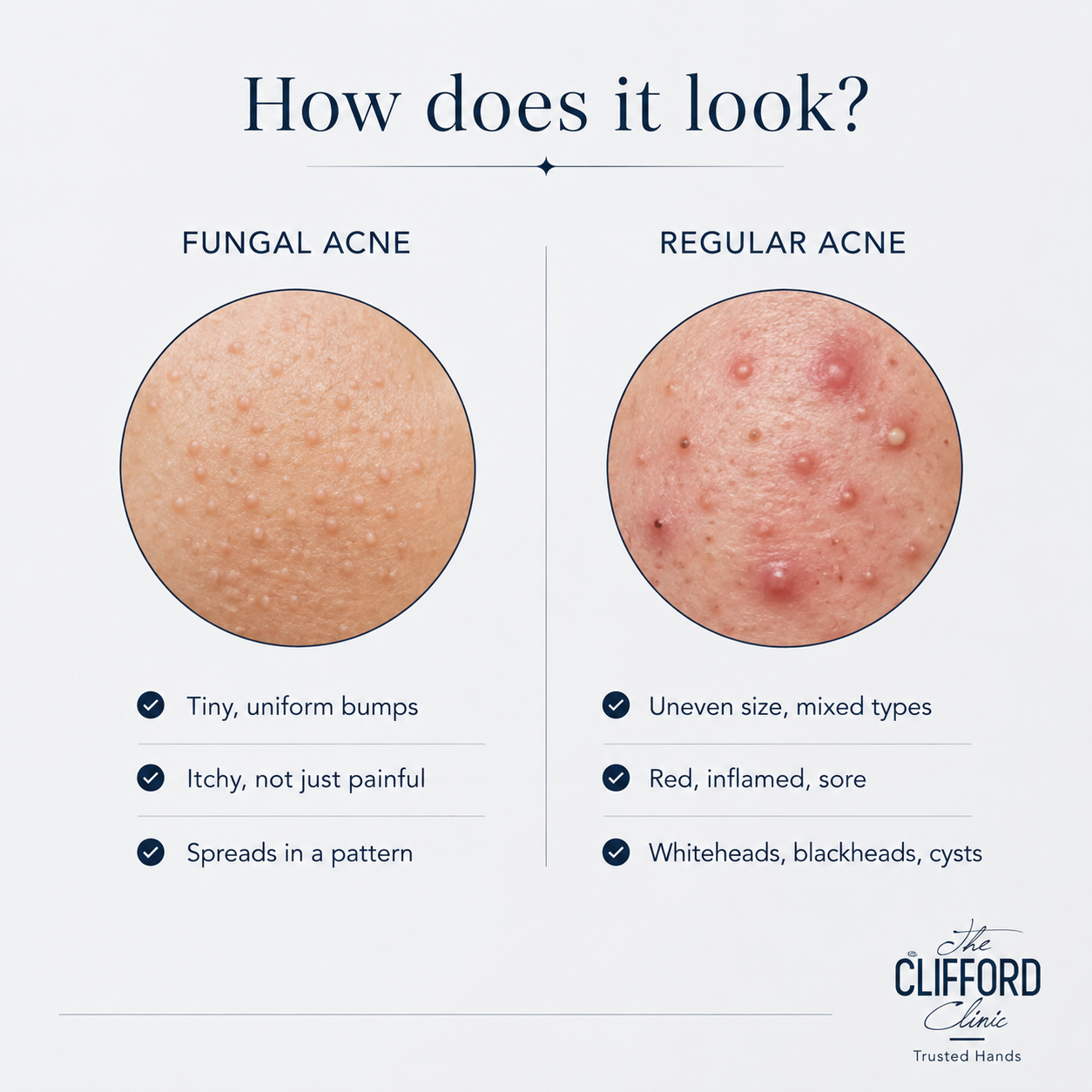
Fungal acne is an overgrowth of Malassezia yeast within the hair follicles rather than a bacterial or comedonal process, which is why it does not respond to the treatments acne requires. The diagnostic clues are papules and pustules of strikingly uniform size, itch rather than tenderness, clustering on the forehead, chest, shoulders and upper back, worsening with sweat and occlusion, and a history of no improvement, or a flare, on standard acne treatment including antibiotics. It responds reliably to topical or oral antifungal treatment, usually within weeks. Because Malassezia is a normal skin resident rather than an imported infection, and because this climate continually favours it, recurrence is likely without maintenance.
The consultation process
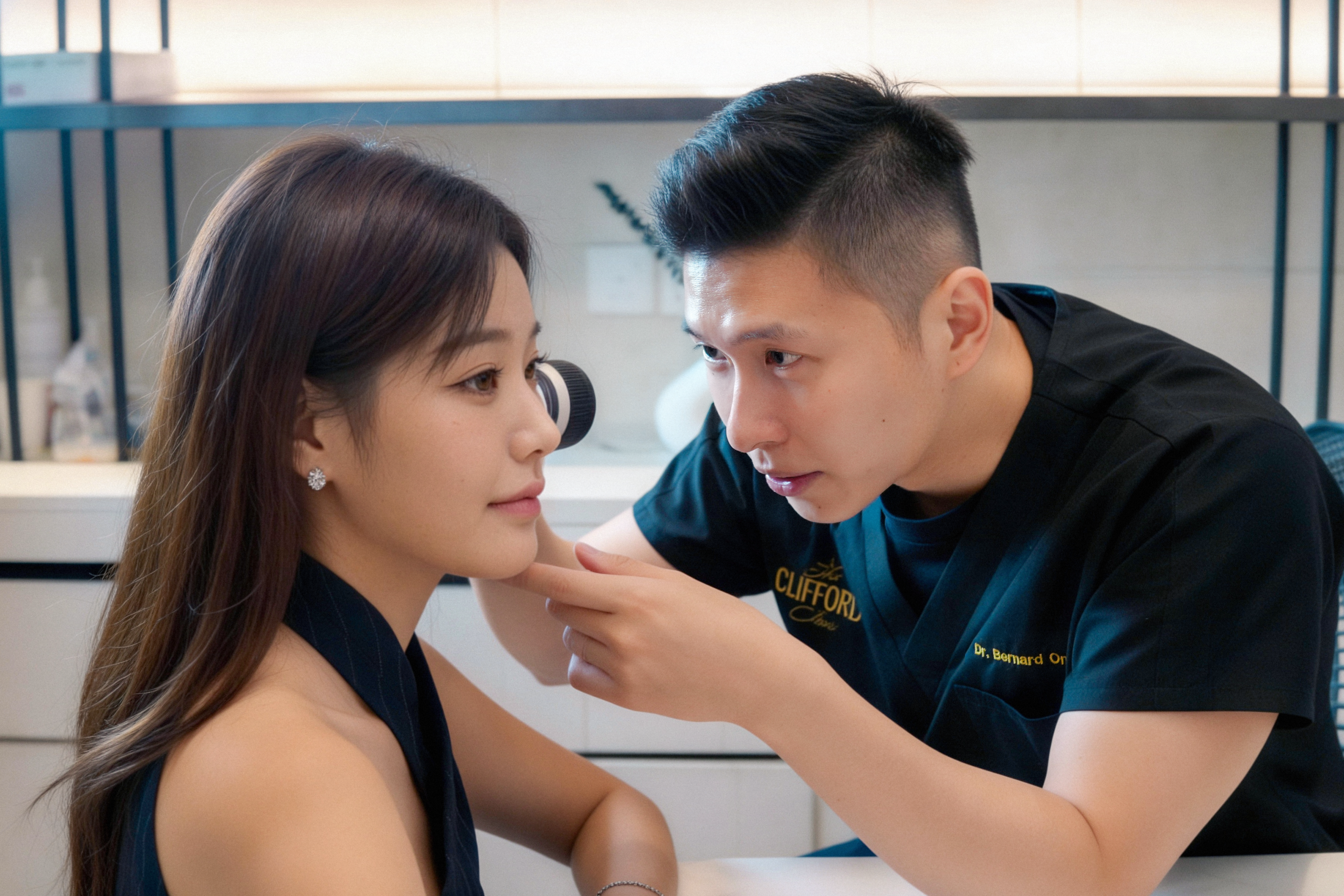
Size uniformity is the most useful visual clue, and it follows directly from the mechanism. Acne vulgaris arises follicle by follicle over weeks, producing a mixed population of blackheads, whiteheads, papules and pustules at differing stages of evolution, whereas Malassezia folliculitis inflames many follicles over a comparable period and therefore produces a monomorphic crop of similarly sized lesions. Itch points strongly towards yeast, as acne is characteristically tender rather than pruritic. Distribution is equally informative, and the chest, upper back, shoulders and hairline are the classic sites, reflecting the density of sebaceous follicles in those areas. The history is often decisive, and three exposures in particular carry weight. A flare that followed an antibiotic course, a change to a heavy sunscreen or occlusive moisturiser, or a period of long humid days in sportswear all describe conditions that favour yeast over bacteria.
Why Singapore’s climate encourages fungal acne growth
Malassezia is a lipid-dependent yeast that lives normally on everyone’s skin and thrives in warmth, humidity and sebum, which it requires as a nutrient source. Singapore supplies all three throughout the year. Skin remains damp beneath clothing, sweat persists after commutes and workouts, and occlusive products trap moisture against the follicular opening. Under these conditions the yeast proliferates within the follicle, and the inflammatory response to that overgrowth produces the visible papules and pustules. Recurrence is therefore common locally even after successful treatment, and maintenance measures form part of the treatment plan rather than optional advice.
Why acne treatment makes fungal acne worse
Oral antibiotics suppress Cutibacterium acnes and other bacteria that normally compete with Malassezia for the same follicular niche, removing that competition and allowing the yeast to proliferate. Patients frequently report that the breakout worsened precisely when antibiotics were commenced for presumed acne. Rich occlusive moisturisers and heavy sunscreens create the damp and oily microenvironment the yeast requires. Certain emollient ingredients compound this, as Malassezia cannot synthesise its own fatty acids and metabolises the fatty acids and oils supplied by many moisturisers. The treatments that would resolve it, topical or oral antifungals, form no part of a standard acne regimen. This mismatch accounts for the characteristic history of months of escalating acne treatment without progress.
How fungal acne is treated
Treatment is directed at the yeast rather than at bacteria, which is the single change that resolves most cases. Topical antifungal preparations clear many cases, including azole creams and ketoconazole or selenium sulphide shampoos applied to the chest and back as a short-contact wash and rinsed off after several minutes, which suits large truncal areas that creams cover poorly. More extensive or resistant involvement may warrant a course of oral antifungal medication, prescribed and monitored under medical supervision because of the potential for drug interactions and effects on liver function. Alongside the medication the environment is addressed, through prompt showering after sweating, a change out of damp clothing, substitution of lighter non-occlusive moisturisers and sunscreens, and reduction of prolonged occlusion where practical. Because the yeast is a normal skin resident rather than an organism to be eradicated, the therapeutic aim is suppression to a level the skin tolerates, and intermittent maintenance is often required to sustain that in this climate.
When treatment is not recommended
Acne antibiotics are not continued in a presentation consistent with fungal folliculitis, as they can aggravate it. Aggressive acne actives are not layered onto itchy uniform lesions, as they irritate the skin without addressing the cause. Equally, the assumption that every truncal breakout is fungal is avoided, as the error is as costly in that direction. Mixed presentations are common, and some patients have both conditions concurrently, which requires a plan addressing each rather than a single diagnostic label.
Common mistakes in fungal acne management
The commonest is months of acne treatment directed at a yeast condition, sometimes across several antibiotic courses each of which worsened it. The second is self-diagnosis from social media followed by aggressive antifungal use on what is in fact acne, which delays correct treatment in the opposite direction. The third is treating the episode while ignoring the environment, which makes recurrence near certain in this humidity. The fourth is heavy occlusive skincare adopted to soothe the irritation, which supplies the yeast with both the lipids and the humidity it depends on.
Evidence in fungal acne treatment
Malassezia folliculitis is a distinct entity from acne vulgaris, characterised by monomorphic follicular papules and pustules, frequent itch, and truncal predominance, and it is recognised in the dermatological literature as one of the most commonly misdiagnosed mimics of acne. Where the diagnosis is uncertain, potassium hydroxide microscopy of a lesion scraping demonstrates the yeast directly and settles the question. Topical and oral antifungal therapy are both effective, with response typically faster than acne treatment timelines, although relapse after treatment is common and is the reason maintenance is planned from the outset. Antibacterial therapy can precipitate or worsen the condition, which is consistent with the wider case for antibiotic stewardship in acne, where guidance is to avoid antibiotic monotherapy and to limit systemic courses to three or four months. Heat, humidity, occlusion and sebum are identified promoting factors, which is the evidential basis for the environmental measures used alongside medication to reduce recurrence.
Realistic expectations with fungal acne treatment
Improvement is faster than with acne, often appearing within two weeks of correct antifungal treatment, and the itch generally settles first. Some recurrence risk persists in this climate, and it is managed with intermittent maintenance rather than repeated full courses. Any coexisting acne continues to require its own treatment, and the marks left behind fade over subsequent months provided photoprotection is maintained.
When to see a doctor
Medical assessment is warranted where a breakout is itchy, uniform in size, concentrated on the chest, back or forehead, or has failed to improve or has worsened on acne treatment and antibiotics. This is a diagnosis worth confirming, as the correct treatment resolves the condition quickly whereas the incorrect one can prolong it for months.
Habits that prevent fungal acne in the Singapore climate
Because Malassezia is a normal skin resident rather than an infection acquired externally, long-term control depends on denying it the conditions it requires. Prompt showering after sweating is more consequential here than in temperate climates, as is a change out of damp gym clothing rather than a commute home in it. Lighter non-occlusive moisturisers and sunscreens reduce the trapped moisture film the yeast favours, and breathable natural fabrics are preferable to tight synthetics across the chest and back. Where headwear, helmets or backpacks create sustained occlusion, regular cleaning of the equipment and scheduled dry intervals for the skin reduce the risk.
None of this requires an elaborate regimen, and the temptation to construct one should be resisted, as product layering is part of what created the problem. A simple, light and dry routine is the governing principle, supported by intermittent antifungal maintenance where a patient has proved prone to recurrence.
When acne and fungal folliculitis coexist
Mixed presentations are common and account for much of the diagnostic confusion. A patient may have genuine acne on the face and Malassezia folliculitis across the chest and shoulders, or both processes overlapping in the same area, particularly after a course of antibiotics. The distinguishing feature is a mixed population of lesions, in which varied sizes and comedones indicate acne while crops of uniform itchy papules indicate yeast. In these cases the plan addresses both, usually beginning with the antifungal component because it resolves fastest and clarifies what remains, before treating the acne on its own timeline. Attempting to resolve both processes under a single diagnostic label is why these patients often present after months of partial improvement.
Frequently asked questions
How do I know if I have fungal acne?
Suggestive features are papules of very uniform size, itch rather than tenderness, clustering on the forehead, chest and upper back, worsening with sweat, and failure to improve, or a flare, on acne antibiotics.
Why does fungal acne get worse with antibiotics?
Antibiotics reduce the bacteria that normally compete with Malassezia for the same follicular niche, allowing the yeast to overgrow within the follicles. A course prescribed for presumed acne can therefore make the breakout worse.
Is fungal acne common in Singapore?
Malassezia folliculitis is frequently encountered in Singapore. Warmth, humidity, sweat and occlusion all favour Malassezia growth, and all are present throughout the year locally, which also makes recurrence more likely without maintenance.
How long does fungal acne take to clear?
With correct antifungal treatment, improvement often appears within two weeks, and the itch settles first. Intermittent maintenance and the environmental measures then reduce the likelihood of recurrence, which is the limiting factor in this climate rather than the initial response to treatment.
| Itchy, uniform bumps that do not respond to acne treatment warrant an accurate diagnosis.
The Clifford Clinic, 50 Raffles Place, Singapore Land Tower. Call (65) 6532 2400 or WhatsApp (65) 8318 6332 to arrange a consultation. |
Related reading
- Best Acne Treatment in Singapore, A Doctor-Led Guide
- Acne Treatment at The Clifford Clinic
- 12 Reasons Acne Treatment Fails
- Types of Acne and How to Treat Them
- Fungal Acne Explained (Dr Rachel Ho)
- Acne Care (The Skin Longevity Clinic)
Selected References
- HealthHub Singapore. Acne. https://www.healthhub.sg/a-z/diseases-and-conditions/acne.
- American Academy of Dermatology. Guidelines of care for the management of acne vulgaris. https://www.aad.org/member/clinical-quality/guidelines/acne.
- DermNet. Acne vulgaris. https://dermnetnz.org/topics/acne.
- Chalupczak NV, Lipner SR. Malassezia folliculitis, an underdiagnosed mimicker of acneiform eruptions. J Fungi (Basel). 2025. PubMed. https://pubmed.ncbi.nlm.nih.gov/41003208/.
- Dreno B, Thiboutot D, Gollnick H, et al. Antibiotic stewardship in dermatology, limiting antibiotic use in acne. Eur J Dermatol. 2014. PubMed. https://pubmed.ncbi.nlm.nih.gov/24721547/.
- Guidelines of care for the management of acne vulgaris. JAAD. https://www.jaad.org/article/S0190-9622(23)03389-3/fulltext.
Medical disclaimer: The Clifford Clinic publishes this article as general patient education only. It is not a substitute for an in-person clinical assessment, and the suitability, outcome and risk profile of any treatment differ from patient to patient. Arrange a consultation with one of our doctors before beginning treatment for acne.

Author Bio
Dr Gerard Ee

Dr Gerard Ee is the Medical Director of The Clifford Clinic in Singapore. He earned his medical degree from St George's University of London and built his surgical experience across the Singapore General Hospital, National University Hospital, and Mount Sinai Hospital in New York. He holds Membership of the Royal College of Surgeons (Edinburgh) and a Postgraduate Diploma in Dermatology (Cardiff), and is fully accredited in aesthetic procedures including botulinum toxin, fillers, lasers, and light therapies. A strong advocate of minimally invasive, natural-looking results, Dr Ee has published in several medical and scientific journals and presented his research in cities including Taipei, Las Vegas, and London.
See all posts by Dr Gerard Ee »