


PRP Injections for Knee Osteoarthritis: How They Work and Who They Help
Written by Dr Gerard Ee
Sharp pain in the knees when climbing stairs, knee ache after long walks, or stiffness in the knees after sitting for long periods of time are some of the most commonly reported joint related problems faced by patients in Singapore.
For most, the cause of these problems is osteoarthritis (OA) — the gradual wear of the smooth cartilage that cushions the knee. While surgery is often touted as the “cure” for knee OA, not all knee OA cases are severe enough to warrant full-blown surgery. When the pain experienced is mild to moderate, non-surgical options like Platelet-Rich Plasma (PRP) injection for knee osteoarthritis have risen in popularity recently as non-invasive alternative to joint replacement surgery (arthroplasty) or bone realignment surgery (osteotomy).
If you would like to learn about what PRP is and how it can help you, do continue reading as this guide will explain, with clinical perspective from Dr Gerard Ee, founder of The Clifford Clinic and Surgery, how PRP treatment is thought to work in an arthritic knee, where PRP is derived from, what the current medical literature and evidence behind PRP treatment actually shows, and who tends to benefit most from this form of treatment.
What Is a PRP Injection?
PRP stands for platelet-rich plasma. PRP is an autologous treatment, meaning that the material being injected during the treatment comes from your body; PRP is made from your own blood. One of the main advantages of autologous treatments are thus their low risk of triggering allergy or rejection.
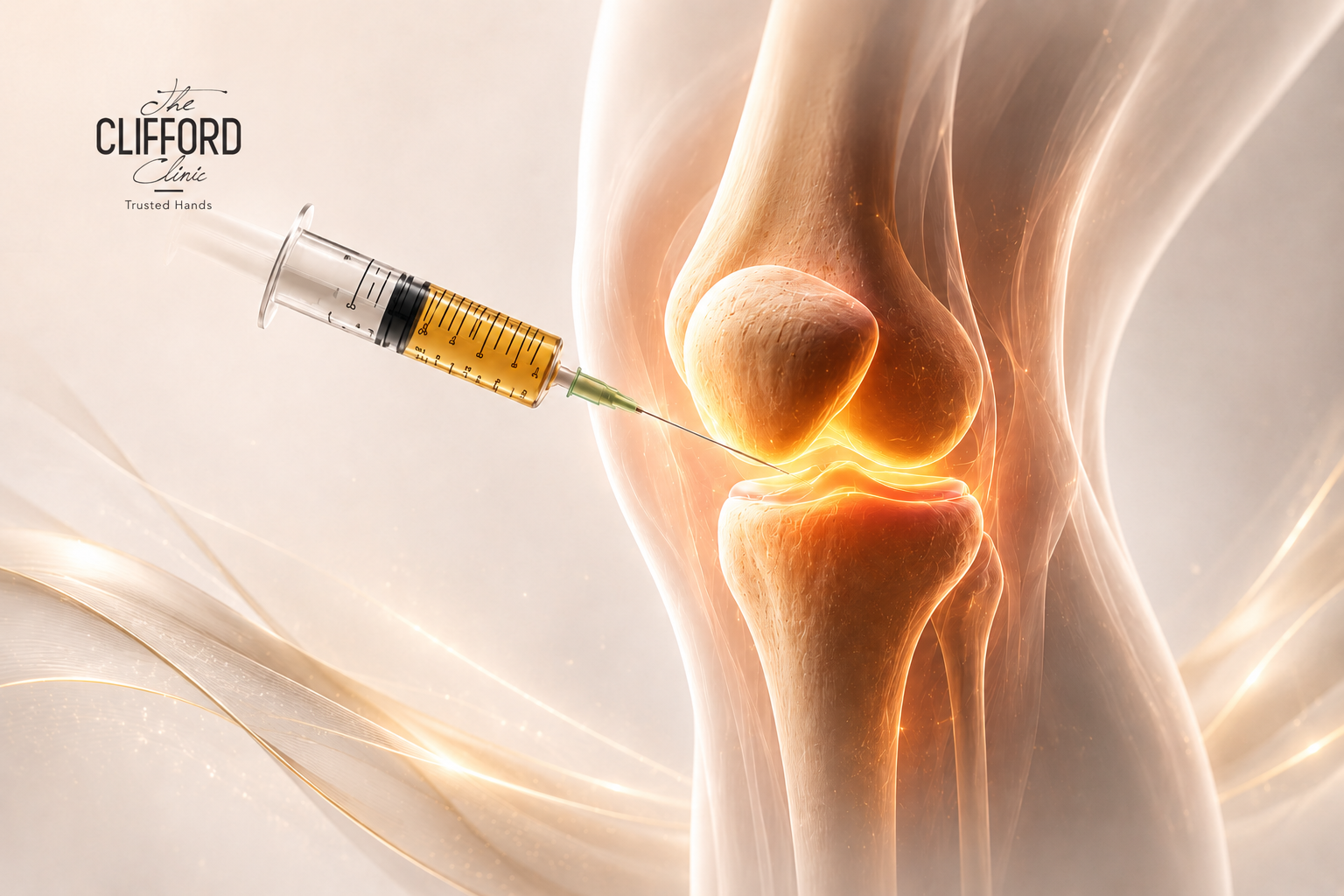
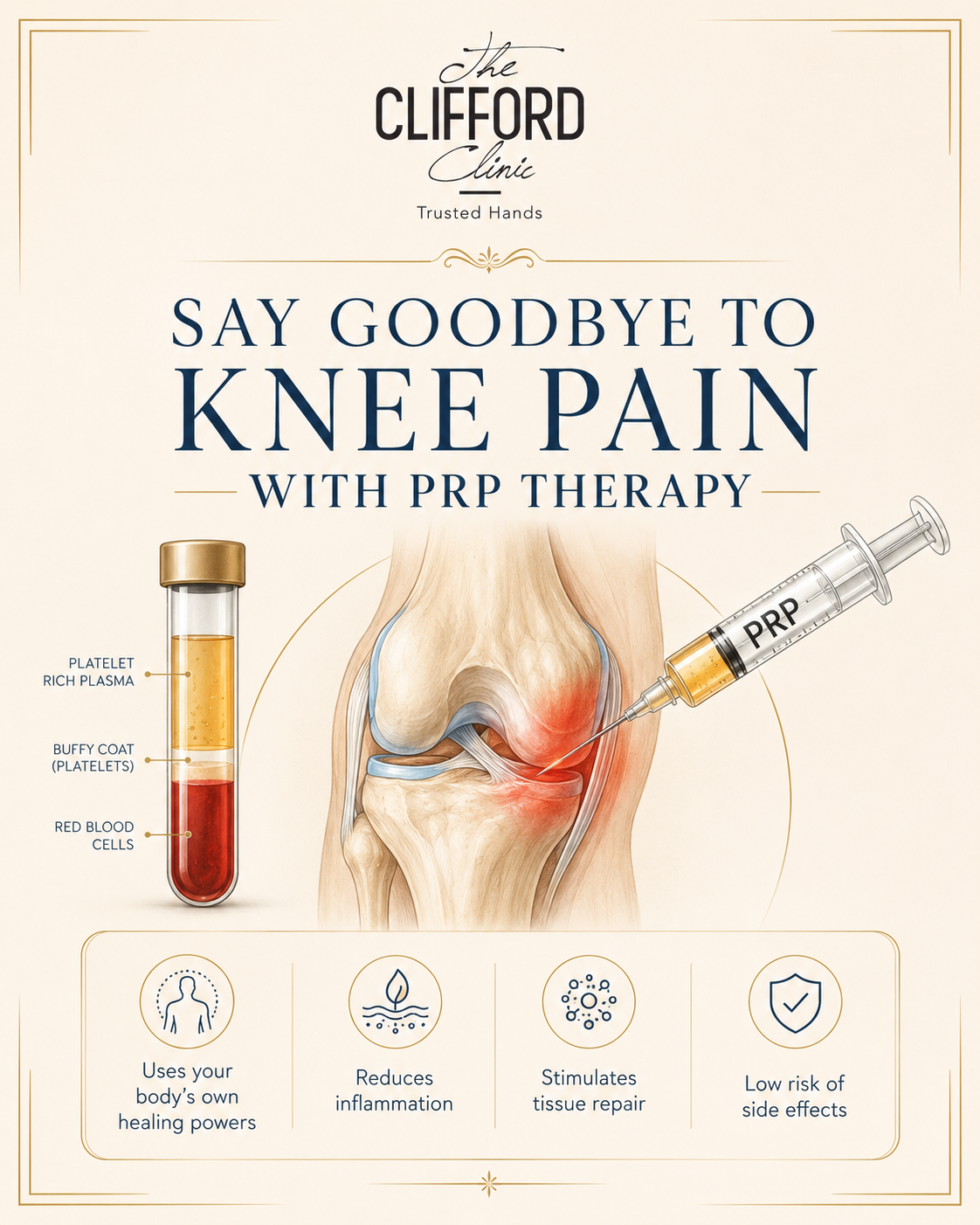
The process of undergoing knee PRP treatment is fairly straightforward. First, similar to a routine blood test, a small sample of blood is drawn from the patient. This sample is then placed into a centrifuge which will spin it at high speed to separate it into its main components: red blood cells, white blood cells, platelets, and plasma.
What are blood platelets? Platelets (thrombocytes) are cell fragments vital for hemostasis, the biological process that stops bleeding. When tissue is damaged, platelets aggregate to form a clot that “plugs” the wound. While they are perhaps best known for facilitating blood clotting, platelets also contain cytokines and growth factors (biological signaling molecules involved in tissue repair and inflammation control) that are vital for promoting wound healing and tissue regeneration.

PRP treatment taps into healing and regenerative properties of the blood platelets to treat knee OA. The role of the centrifuge is to concentrate these platelets into a small volume of plasma that can be extracted as the is the “platelet-rich plasma,” and it is injected directly into the knee joint.
How PRP Is Thought to Work When Treating Knee Osteoarthritis
Before we continue, we feel it is important to clear some misconceptions and clarify that PRP cannot grow a brand-new knee for patients, nor can it reverse established arthritis. What PRP treatment for knee OA aims to achieve is the improvement the biological environment inside the joint.
Osteoarthritis is not caused by just “wear and tear”, it is also characterized by the presence of a low-grade inflammatory process within the joint lining (the synovium) that contributes to pain and ongoing cartilage stress. PRP delivers a concentrated dose of growth factors and signaling proteins that are thought to:
- Help modulate inflammation within the joint
- Support a healthier joint environment that is less hostile to remaining cartilage
- Influence the cells of the synovium and cartilage in ways that may reduce pain and improve function
While the current and honest medical/scientific consensus is that the precise mechanism behind PRP treatment for knee OA is still being studied, what most patients likely are more concerned with is the outcome of PRP treatment in practice, which is: in suitable patients with mild to moderate knee OA, PRP is shown to reduce pain and make movement more comfortable, which in turn makes it easier to stay active and complete rehabilitation.
What Does the Scientific Evidence Say?
As we pride ourselves on only conveying accurate and unbiased information, we feel that any discussion around the use of PRP should be balanced. Over the past decade, a growing number of randomized controlled trials and meta-analyses examining PRP for treating knee OA generally suggests that PRP can reduce pain and improve function in mild to moderate cases of knee OA. Several clinical studies also indicate that the benefits of PRP may last longer than those of hyaluronic acid hyaluronic acid (viscosupplementation) in patients with mild to moderate knee OA.
However, it is also important to acknowledged that the results and evidence obtained from these various clinical studies are not uniform; Preparation methods may differ between studies and between clinics, which makes results harder to compare. In addition to this, the response to PRP is not the same between patients as depending on their physiology, some patients respond very well to the treatment while others notice only modest change/improvement.
Crucially, PRP works best in the earlier-stages of osteoarthritis when there is still cartilage present to protect. In later stages or the end-stage od knee OA, also known as “bone-on-bone” arthritis, PRP is much less likely to deliver meaningful relief and other treatment options should be discussed.
In short, PRP is best understood as a tool that can help a suitable patient, not a guaranteed cure for every knee.
Who Is a Good Candidate for PRP?
Platelet-rich plasma injections tend to be most effective for patients who:
- Have mild to moderate knee osteoarthritis (to be confirmed via assessment and imaging).
- Experience activity-related knee pain that limits their ability to comfortably climb stairs, walk, squat or participate in sports.
- Want a non-surgical option, or want to delay knee replacement surgery.
- Did not respond well to or only achieved partial relief with physiotherapy, strengthening, and/or weight management.
As mentioned above, PRP is generally less suitable for patients with end-stage arthritis. PRP is also not recommended for patients with active joint infection, certain blood disorders, or knee pain that is a result of something other than knee OA, for example, knee pain caused by a mechanical meniscus tear or referred pain from the hip or spine.
Accurate diagnosis of the cause of the pain is thus always vital before committing to any treatment. If you are unsure what is the root cause of your knee pain, we welcome you to drop by our clinic for a consultation with Dr Ee.
The PRP Treatment Process at The Clifford Clinic
At our clinic, this is the outline of a typical knee osteoarthritis PRP treatment session:
- Consultation and diagnosis – During the pre-treatment consultation session, our doctor(s) will conduct a focused knee examination and review of knee imaging results to determine if osteoarthritis is indeed the true source of the patient’s pain and how advance their knee OA is. Our doctor(s) will also ask the patient for their detailed medical history to aid in the diagnosis process.
- Drawing of the blood sample – A small sample of the patient’s blood will be collected.
- PRP Preparation – The collected blood sample is processed in the clinic using a centrifuge to concentrate the platelets.
- Precision-guided injection – The harvested PRP is injected into the patient’s joint using a careful and precise technique that employs the use of imaging guidance for improved accuracy.
- Post-treatment review and rehabilitation– A post-treatment consultation session with our doctor(s) will be arranged to ensure that the patient is healing well. Treatment progress will be reviewed against functional markers such as walking tolerance and comfort during physical exertion (e.g. When climbing stairs).
What to Expect After a PRP Injection
Mild soreness, stiffness, or a sense of “fullness” in the knee for around one to three days after the PRP injection is normal as the treatment usually provokes a temporary reactionary biological response. However, most patients can expect to return to light daily activities after the procedure as soon as these temporary side effects subside. Do note that high-impact loading/activity such as running, jumping, or heavy leg training is not recommended and should not be attempted immediately after the injection.
We would also like to caution that improvement is gradual rather than instant. PRP treatment is like a steroid injection, it is not a “switch” that can instantly “turn off” pain. Rather, the benefits of PRP are long term and tend to build over several weeks. Pairing the PRP injection with a structured strengthening and physiotherapy program is recommended (or essential, depending on the severity of the knee OA) as long-term knee comfort depends on rebuilding the muscle support around the joint.
Expert Opinion: The Clifford Clinic’s Approach to PRP
At The Clifford Clinic, PRP is never offered as a one-size-fits-all solution; Dr Gerard Ee and our medical team take a personalised, stepwise approach to all knee OA cases. The treatment approach/program is personalized to match to each patient’s OA grade, age, weight, and activity level as we do not believe in the use of a single type of treatment as a blanket treatment for all patients.
Two key principles shape how PRP is used in our clinic; Firstly, accurate diagnosis comes before any decision. Knee pain can originate in the joint, the meniscus, the tendons, or even be indirectly caused by an injury/problem originating from elsewhere in the body. As PRP only helps when the problem is genuinely cause by knee OA, we are very meticulous when it comes to diagnosing the root cause of the patient’s knee pain.
Secondly, the accuracy of the delivery of the PRP injection matters; The Clifford Clinic and Surgery places an emphasis on using a precise and well-targeted injection technique to ensure that the PRP reaches exactly where it is intended to act for the best treatment outcomes.
Additionally, our clinic also frames PRP honestly as one component of a broader treatment plan. The end goal of our clinic is never to just suppress the pain via an injection, rather, we always aim to provide a holistic treatment that not only relieves pain, but also allow the patient to rebuild strength, manage load, and, where possible, delay or avoid the need for knee replacement surgery.
Honesty and communication is likewise important to us. Our doctors will always ensure that patients are given realistic timelines and clear follow-ups rather than empty promises of an immediate cure.
PRP and the Bigger Picture
PRP works best when it is used as a part of a complete treatment strategy; Weight management to reduce the load passing through the knee with every step, targeted strengthening of the quadriceps and hip muscles to improve how the joint is supported and controlled, and/or activity modification to help patients stay active without repeatedly aggravating the affected joint may also be recommended by our doctors in conjunction with the PRP injection.
For many patients with mild to moderate knee osteoarthritis, a combination of the above listed behavioural modifications with a precisely delivered regenerative injection is usually what keeps knee OA from worsening, buying more years of comfort and active living.
Frequently Asked Questions
Is a PRP knee injection painful?
Most patients describe brief discomfort similar to being pricked by a needle, and a short-lived pressure or stinging sensation during the joint injection. Mild soreness for a day or two afterwards is common and expected.
How soon will I feel improvement after PRP?
PRP works gradually, it is not an instant cure. Many patients start to notice positive changes over several weeks rather than immediately. Our doctor(s) will review your progress against functional goals to help you track your improvement.
How many PRP injections will I need?
This varies with the severity of your osteoarthritis and how well your knee responds to PRP. Do note that PRP is commonly delivered as a short course and your personalised treatment plan will be confirmed during your consultation session with our doctor(s).
Is PRP better than a hyaluronic acid or steroid injection?
No single type of injection is the “best” for everyone. PRP, hyaluronic acid, and steroid injections all have different mechanisms of action and the right type of injection for you depends on your diagnosis, OA grade, and treatment goals.
Can PRP help me avoid knee replacement surgery?
For some patients with mild to moderate osteoarthritis, PRP can reduce pain and improve knee function enough to delay surgery for years. On that note, we would like to mention again that PRP cannot reverse advanced arthritis and treatment outcomes may vary between individuals.
Related Reading
Clinic treatment pages:
Speak to Us About Your Knee Pain
If knee osteoarthritis is limiting your activity or if you want to understand whether PRP is a sensible treatment option for you, the first step is receiving a proper assessment.
Knee assessments and injections at The Clifford Clinic are carried out by an experienced medical team that includes sports physicians and orthopaedic surgeons. The Clifford Clinic is also supported by an MOH-approved day surgery facility.
Knee joint injections may also be claimable through Medisave and insurance — the clinic can advise on your eligibility and coverage at consultation.
The Clifford Clinic 50 Raffles Place, #01-01 Singapore Land Tower, Singapore 048623 (Exit B, Raffles Place MRT) Phone: (65) 6532 2400 | WhatsApp: (65) 8318 6332
About Dr Gerard Ee

Dr Gerard Ee is a physician at The Clifford Clinic whose main specialty is dermatology and aesthetic medicine, and who is also trained in orthopaedic surgery, with a substantial peer-reviewed research record in orthopaedics. His published work spans knee surgery — including studies on total knee arthroplasty and joint line restoration in journals such as The Knee and the Journal of Bone and Joint Surgery (British) — as well as shoulder, spine and bone-healing research in titles including Knee Surgery, Sports Traumatology, Arthroscopy, Clinical Orthopaedics and Related Research and the Journal of Orthopaedic Surgery and Research. This research-informed background underpins the evidence-based, individualised approach to knee care at The Clifford Clinic.
Medical Disclaimer
This article is for general education only and is not a substitute for personalised medical advice. Suitability for PRP or any knee injection can only be determined after an in-person assessment by a qualified doctor. Outcomes vary between individuals.