


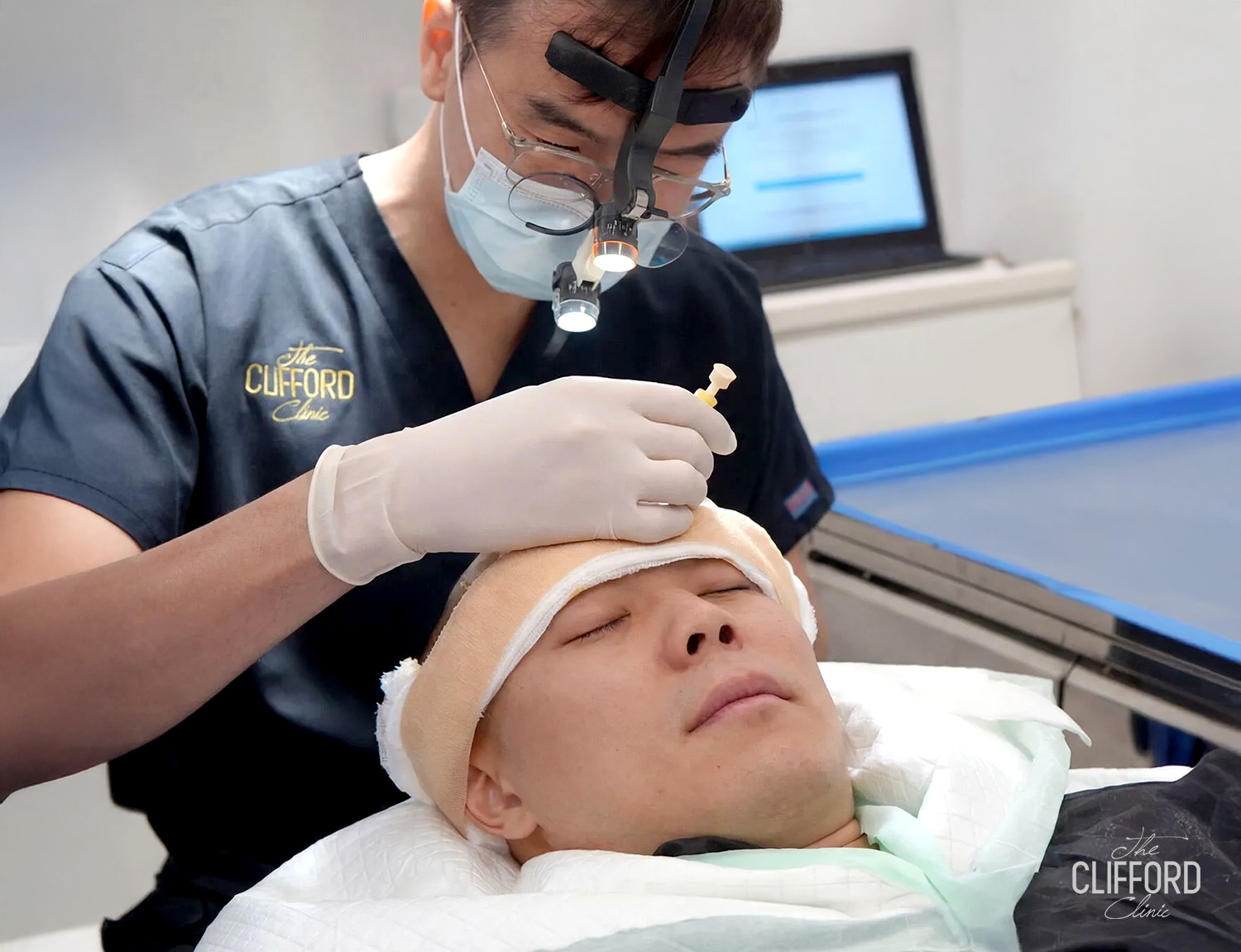
Hair Transplant Singapore vs Bangkok and Kuala Lumpur: Why The Clifford Clinic Offers Better Long Term Value
Hair loss can feel deeply personal. For some people, it begins with a slightly higher hairline in old photos. For others, it is a widening parting, thinning at the crown, or the slow realisation that shampoos, supplements and topical products are no longer giving the result they hoped for.
The reassuring thing is that modern hair restoration has come a long way. A well-planned hair transplant Singapore treatment is no longer about obvious, artificial looking results. Today, it can be subtle, refined and medically tailored to the way your hair naturally grows. At The Clifford Clinic, the focus is not simply on placing more grafts. It is about designing a result that suits your face, protects your donor area and gives transplanted follicles the best possible chance of survival.
A hair transplant works by moving healthy hair follicles from a stable donor area, usually the back or sides of the scalp, into areas affected by thinning or baldness. The Clifford Clinic’s approach to hair restoration Singapore is built around proper scalp assessment, hair density evaluation, donor area planning and treatment goals before recommending a suitable plan.
For many suitable patients, The Clifford Clinic recommends FUE hair transplant. FUE, or Follicular Unit Extraction, removes individual follicular units from the donor area rather than cutting out a strip of scalp. This helps minimise the appearance of scarring and makes the procedure especially suitable for patients who prefer a discreet recovery or shorter hairstyles.
Just as importantly, The Clifford Clinic offers competitive pricing when compared with neighbouring medical tourism destinations. For an estimated 2,000 grafts, patients may expect pricing in the range of SGD$6,000 to SGD$9,900, depending on assessment, graft requirements, case complexity and the final treatment plan. This gives patients a strong local option without automatically assuming that travelling to Malaysia or Thailand will be more cost-effective once flights, accommodation, transport, meals and overseas follow-up visits are included.
Why are more people searching for hair transplant Singapore?
Searches for “hair transplant Singapore” have grown because patients are becoming more informed. People are no longer only asking, “How much does it cost?” They are also asking better questions: Who is performing the procedure? How are grafts handled? What is the recovery like? What happens if I need a review after surgery? Will the final result look natural after 12 months?
These are the right questions to ask. A hair transplant is not a one-day purchase. It is a medical journey that includes consultation, donor assessment, hairline planning, graft extraction, implantation, healing, aftercare, shedding, regrowth and long-term follow-up. The first 7 to 10 days are especially important because the grafts are still settling and the treated area needs to be protected from friction, rubbing and accidental knocks.
This is where a local clinic becomes a real advantage. When you do your hair transplant in Singapore, you can recover at home, attend reviews more easily and speak to the clinic without navigating overseas logistics. That convenience matters, especially when small questions can feel urgent during the early recovery stage.
The pricing also deserves a realistic look. A 2,000-graft estimate at The Clifford Clinic, ranging from SGD$6,000 to SGD$9,900, is competitive when you compare the full treatment experience, not just the advertised procedure fee. The upfront price of a hair transplant Bangkok or hair transplant Kuala Lumpur package may appear lower, but the total cost can change quickly when travel, accommodation, time away from work and return visits are added.
What makes The Clifford Clinic stand out
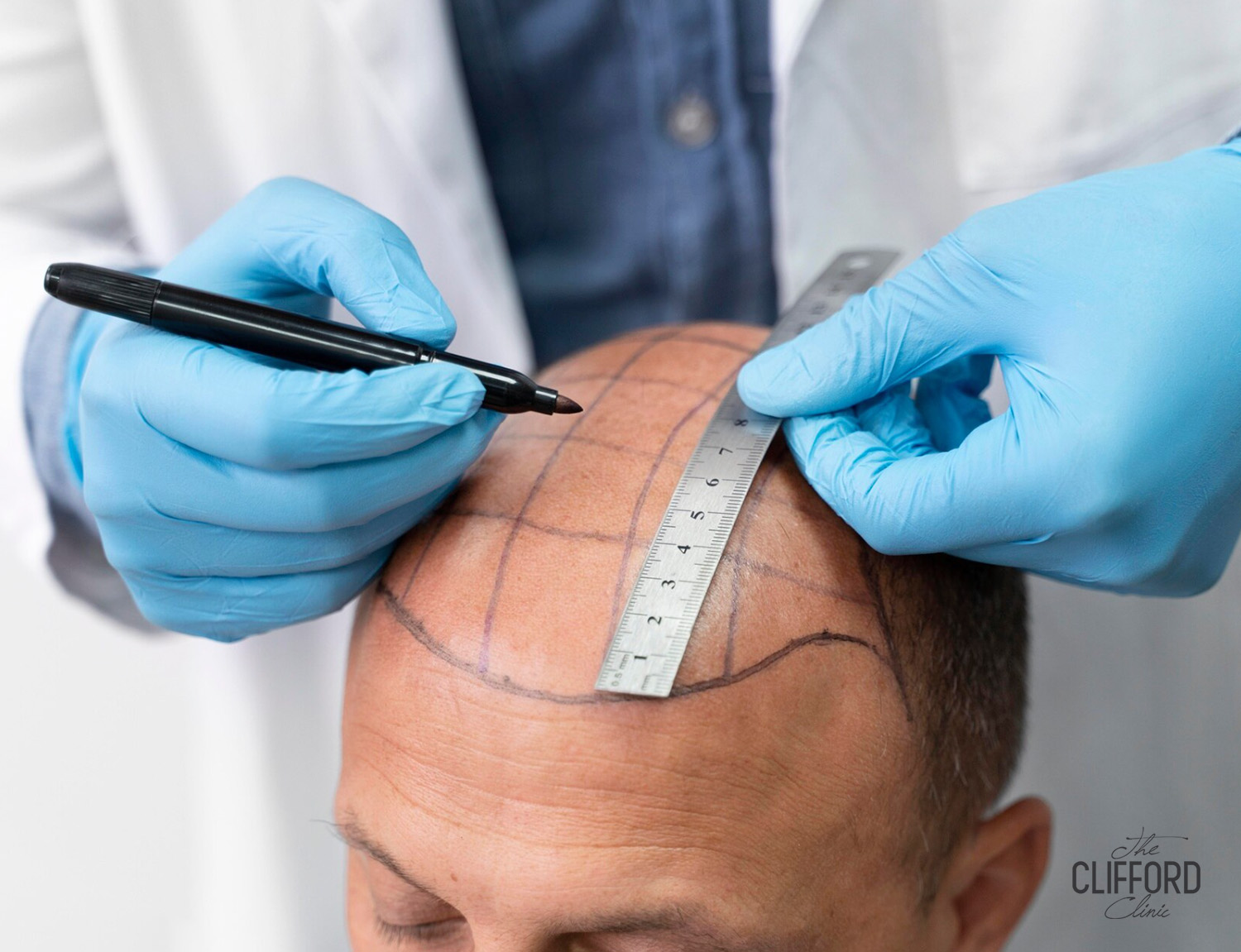
One of the most important points is that graft survival matters more than graft numbers. This is a key medical principle. Every graft taken from the donor area is a limited resource. Once a graft is damaged or fails to survive, it cannot simply be replaced like an ordinary product. Poor graft survival can lead to patchy results, wasted donor hair and a higher effective cost per surviving graft.
This is why experience matters so much. A hair transplant is not only about moving follicles from one place to another. It is a chain of precise steps: donor selection, follicle extraction, graft sorting, graft protection, recipient site creation, angle control, density planning and implantation. Clifford’s FUE page notes that hair transplantation is highly technique-dependent and that the clinic has a full-time team that performs hair transplants regularly.
The clinic also places emphasis on graft care. It uses fine micro-tips selected according to hair root thickness, as well as bio-solution storage to protect grafts while they are outside the body. These details may sound technical, but they matter because graft handling directly affects survival and final growth.
Why FUE is often the recommended approach
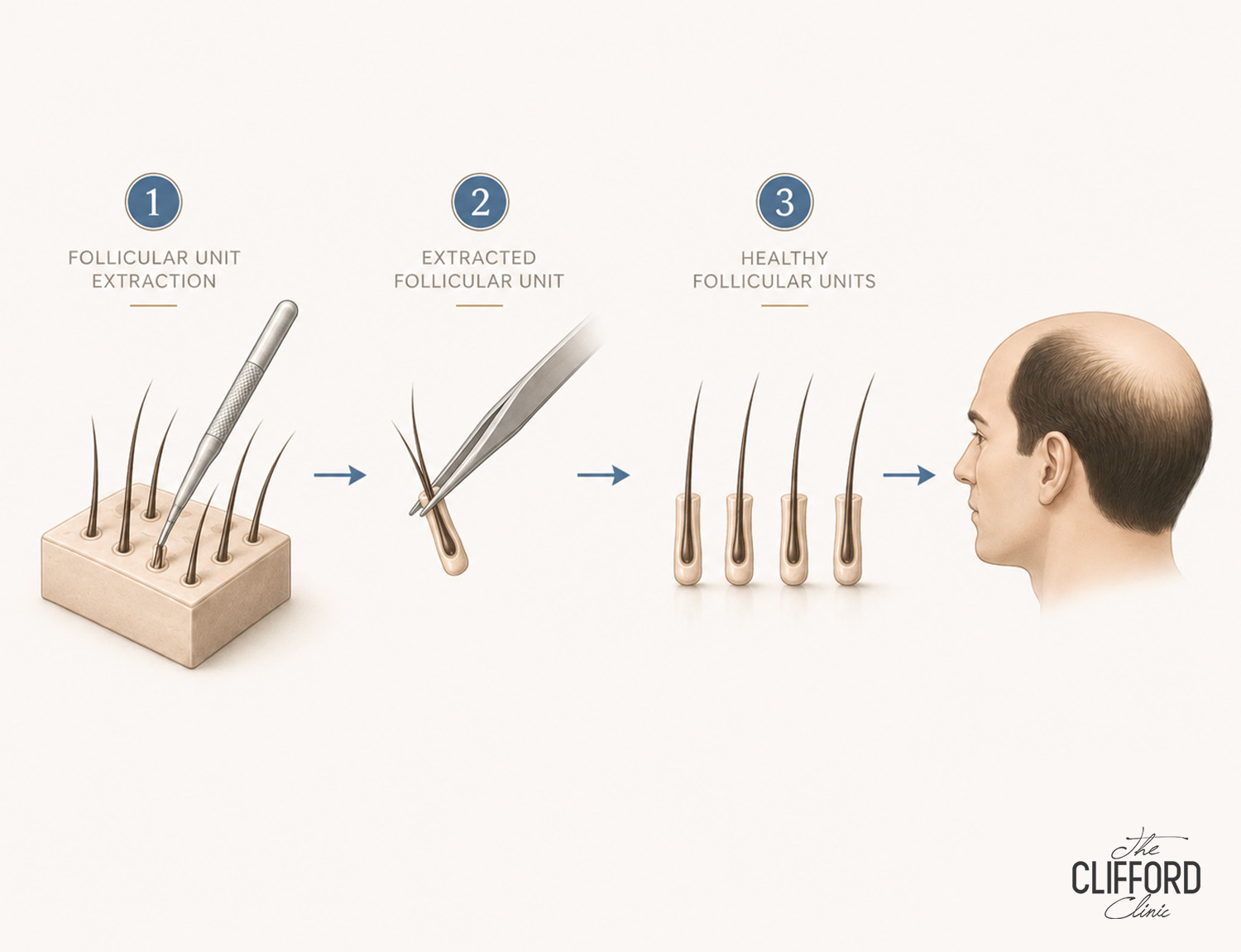
FUE hair transplant is often preferred for patients who want a natural-looking result with minimal visible scarring. Unlike FUT, which removes a strip of scalp and can leave a linear scar, FUE extracts follicular units one at a time from the donor area. This makes it a popular option for patients who want a more discreet procedure and greater flexibility with hairstyles.
At The Clifford Clinic, FUE is recommended because it fits well with modern hair restoration goals: natural hairline design, careful placement, reduced visible scarring and a recovery process that many patients find manageable. Clifford’s FUE page notes that most FUE patients can resume routine activities the day after the procedure, although each patient’s recovery still depends on graft count, swelling and individual healing.
A 2,000-graft case is a substantial but common planning range for many patients seeking visible improvement. A 2,000-graft procedure takes around eight hours on average, while a 1,000-graft case takes around five hours. This helps patients understand that pricing reflects not only graft count, but also procedure time, team involvement, graft handling and implantation precision.
Hair transplant Singapore vs hair transplant Bangkok
It is understandable why some patients compare hair transplant Singapore with hair transplant Bangkok. Thailand has a well-known medical tourism industry and lower advertised procedure fees can look attractive at first glance. Regional reporting has noted that Thailand and Malaysia are more appealing than Singapore to medical tourists who are mainly looking for less costly healthcare treatments.
However, a lower headline price does not always mean a lower final cost. A Singapore-based patient considering hair transplant Bangkok may need to add flight tickets, hotel accommodation, airport transfers, meals, travel insurance and time away from work. Some patients may also need to stay longer for early review or return again if they have concerns during recovery.
This is especially relevant for hair transplant surgery because aftercare matters. Proper hair transplant aftercare involves following the specialist’s instructions, avoiding washing too soon, protecting the scalp from sun exposure and not scratching or rubbing the treated area. These steps are designed to promote healing and protect the results.
For a local patient, doing the procedure in Singapore means early questions can be addressed more easily. If there is redness, swelling, scabbing, shedding, or uncertainty about washing, you can contact the clinic without dealing with international travel arrangements.
The CDC also warns that medical tourism can involve continuity of care issues and that patients may need follow-up care if complications occur after returning home. Such follow-up care can be expensive and may not always be covered by insurance.
This does not mean every hair transplant Bangkok clinic is unsuitable. It simply means patients should compare the full cost of care. When The Clifford Clinic’s 2,000 graft estimate of SGD$6,000 to SGD$9,900 is viewed alongside the convenience of Singapore based aftercare, the local option becomes much more compelling.
Hair transplant Singapore vs hair transplant Kuala Lumpur
The same applies when comparing hair transplant Singapore with hair transplant Kuala Lumpur. Kuala Lumpur may seem attractive because it is nearby, familiar and often marketed at lower prices. For some Singapore patients, the idea of crossing the border for a procedure may feel simple.
But hair transplant planning is rarely just “go in, get grafts, go home.” A patient considering a hair transplant in Kuala Lumpur may still need transport, accommodation, pre-procedure consultation, procedure day recovery, post-procedure review and possibly a return visit. If the clinic recommends staying for monitoring, hotel costs and time away from normal routines should be added to the budget.
This is where The Clifford Clinic’s pricing becomes meaningful. An estimated SGD$6,000 to SGD$9,900 for around 2,000 grafts gives Singapore patients a local treatment option that is not only medically established, but also competitive when hidden overseas costs are considered. The savings from travelling may be smaller than expected once the full journey is calculated.
There is also peace of mind in having your treatment records, doctor and aftercare team in the same country where you live. During the first few weeks, patients may experience expected changes such as mild swelling, scabbing, itch, or shedding. Having easy access to professional guidance can make the recovery process less stressful.
For patients who value convenience, continuity and accountability, a hair transplant Singapore procedure at The Clifford Clinic can be a strong alternative to overseas medical tourism.
Singapore’s medical standards and why they matter
One reason many patients choose hair transplant Singapore is the healthcare environment. Singapore’s Ministry of Health states that the Healthcare Services Act regulates healthcare services through a services-based framework, with a risk-based approach to determining the healthcare services regulated under the Act. Healthcare providers offering regulated services need to hold the relevant licences before providing them.
For patients, this matters because hair transplantation is still a medical procedure. It may be minimally invasive, but it involves the scalp, donor follicles, local anaesthesia, wound healing, infection prevention and post-procedure care. A regulated healthcare environment gives patients a clearer framework for safety and accountability.
The Clifford Clinic builds on this Singapore advantage by combining clinical experience with personalised treatment planning. The clinic assesses hair loss pattern, donor hair, scalp condition and goals before recommending a suitable plan. This matters because the best hair transplant is not necessarily the one with the most grafts. It is the one that uses the right number of grafts in the right places, with long-term planning in mind.
When a patient is planning for approximately 2,000 grafts, the goal is not just to fill space. It is to create a natural-looking improvement while preserving donor hair for the future. That is why a medically guided plan is so important.
What to expect during a FUE hair transplant
A FUE hair transplant at The Clifford Clinic usually begins with consultation and assessment. The doctor evaluates the patient’s pattern of hair loss, donor area, hair calibre, scalp health, medical history and goals. This consultation helps determine whether FUE is suitable, how many grafts may be needed and whether other hair loss treatments should be included in the plan.
During the procedure, healthy follicles are extracted from the donor area, commonly the back or sides of the scalp. These follicles are then prepared and implanted into thinning or balding areas. The aim is to place grafts in a way that follows the natural direction, angle and density of the patient’s existing hair.
A typical 2,000-graft case takes around eight hours on average. This is a helpful planning point for patients because it shows why hair transplantation is detailed, time-intensive work rather than a quick cosmetic appointment.
Recovery and hair growth timeline
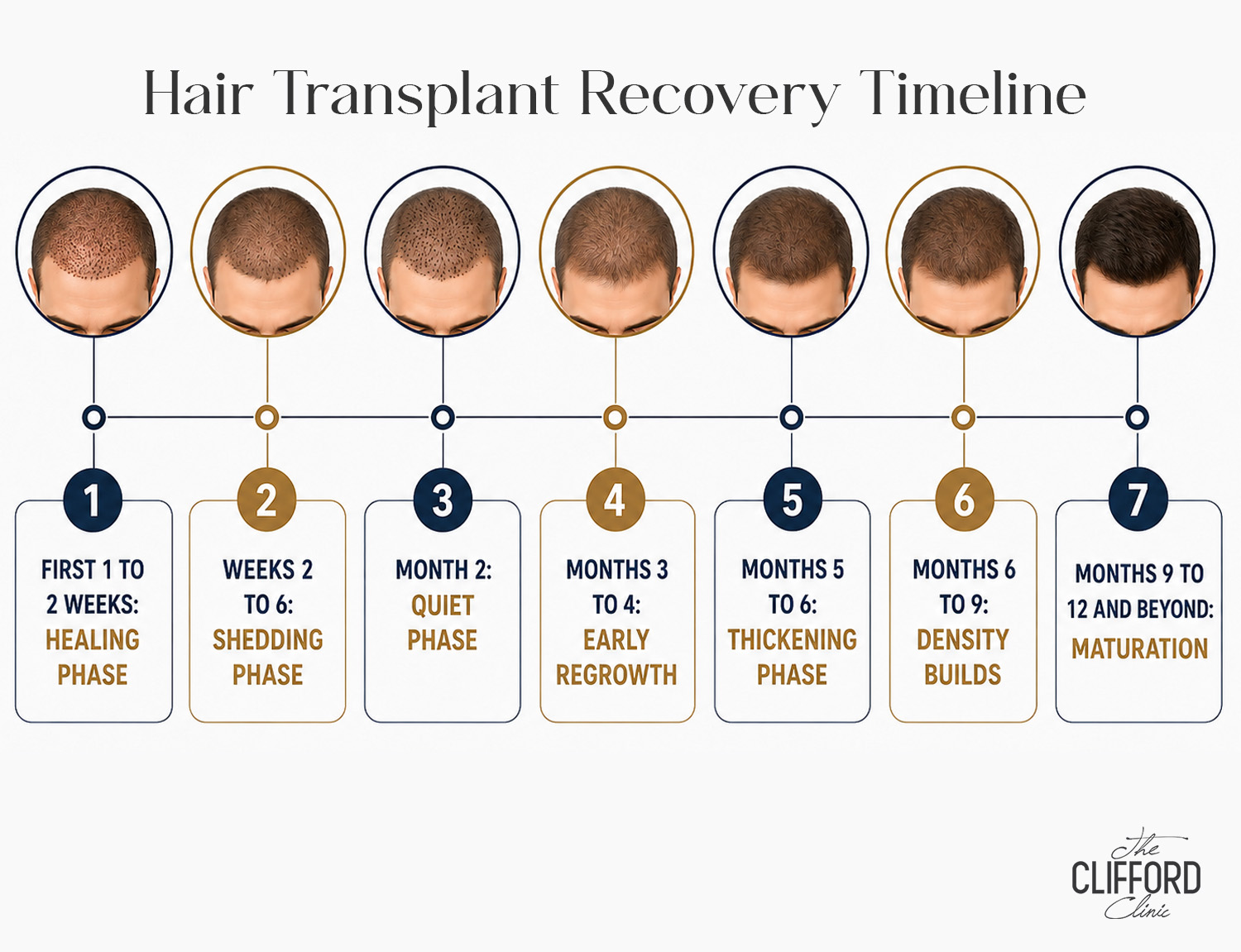
Patients often want to know when they will see results. This is where patience is important.
In the first week, the main priority is protecting the grafts. The recipient area should be kept clean and patients should avoid friction, rubbing, or accidentally knocking the grafts while they anchor into place. If a bandage is used, it may be removed the next day and gentle washing is usually introduced according to the doctor’s method.
In the first few weeks, some swelling, tightness, tenderness, or scabbing may occur. Patients should not pick at scabs, scratch the scalp, or wash too aggressively. Clifford Clinic’s hair transplant aftercare guidance also highlights the importance of protecting the scalp from sun exposure, following specialist instructions and being patient with results.
Shedding can happen after the early healing period and this often worries patients. In many cases, the visible hair shaft sheds while the follicle remains beneath the skin and prepares for new growth. Clifford’s hair transplant page explains that early regrowth usually begins around months three to four, with density building from around months six to nine. Many patients see their more representative result around months nine to twelve, while the crown can continue improving for longer.
This timeline is another reason local aftercare matters. A patient who has gone overseas for a hair transplant in Bangkok or a hair transplant in Kuala Lumpur may have to rely on remote updates after returning home. In Singapore, patients can access The Clifford Clinic more conveniently for follow-up and reassurance.
Cost of hair transplant in Singapore
The cost of hair transplant Singapore depends on the patient’s diagnosis, hair loss condition, number of grafts, method used and treatment complexity.
For practical planning, The Clifford Clinic’s estimate for around 2,000 grafts is SGD$6,000 to SGD$9,900. This gives patients a useful ballpark when considering a fuller hairline, crown improvement, or more noticeable restoration. The final quotation should still be based on medical consultation because no two patients have the same donor density, scalp condition, hair calibre, or long-term hair loss pattern.
This estimate also helps patients compare local and overseas choices more realistically. A cheaper quoted package overseas may not include travel expenses, hotel stays, meals, local transport, medical records, medications, or return visits. If a patient needs to stay in Bangkok or Kuala Lumpur for follow-up checks, the total cost can rise.
The better question is not simply, “Which country has the lowest advertised graft price?” The better question is, “Which option gives me the best combination of medical care, natural results, graft survival, aftercare, convenience and total value?”
For many Singapore-based patients, The Clifford Clinic’s pricing sits in a sensible range. It offers the advantages of local care while remaining competitive once the hidden costs of overseas treatment are considered.
Benefits of choosing The Clifford Clinic for hair restoration Singapore

The Clifford Clinic offers several advantages for patients considering hair restoration in Singapore.
First, the clinic takes a personalised medical approach. Hair loss can be caused by genetics, hormones, stress, pregnancy, autoimmune conditions, and other factors. The Clifford Clinic’s hair restoration page notes that hair loss can affect men, women, young adults, and younger patients, and that treatment should be guided by assessment rather than a one-size-fits-all plan.
Second, the clinic recommends FUE for many suitable patients because it is refined, minimally scarring, and designed for a natural-looking restoration. FUE can help patients achieve visible improvement without the long linear scar associated with FUT.
Third, The Clifford Clinic has experience in graft handling and transplant planning. Its hair transplant page notes that the head technician has more than 10 years of experience and has assisted more than 2,000 patients, while the clinic itself highlights more than 18 years of experience in aesthetic medicine.
Fourth, patients benefit from local aftercare. This is especially important because the journey does not end after implantation. Washing, sun protection, scalp care, follow-up visits and realistic expectations all play a role in the final outcome.
Is FUE right for you?
FUE may be suitable if you have a receding hairline, thinning crown, male pattern hair loss, female pattern hair loss, or areas of reduced density. It may also be suitable for patients who want to avoid a visible linear scar and prefer a technique that allows more flexibility with shorter hairstyles.
However, suitability depends on your donor hair, scalp health, age, medical history, hair loss stability and expectations. Clifford’s FUE page notes that FUE may be suitable for male pattern hair loss, female pattern hair loss and enhancement of areas such as eyebrows, beard, or sideburns, while certain underlying medical causes of hair loss may make a patient unsuitable.
This is why consultation is important. Some patients are ready for a hair transplant. Others may benefit from medical hair loss treatments first. Some may need a combination plan to protect existing hair while restoring areas that have already thinned.
A 2,000 graft plan may be ideal for one patient but excessive or insufficient for another. The goal is not to chase a number. The goal is to create a natural, durable result using the right number of grafts for your individual needs.
Final thoughts: choosing confidence, continuity and care
A hair transplant is not only about growing hair. It is about making a confident medical decision.
Hair transplant Bangkok and hair transplant Kuala Lumpur options may appear attractive when the advertised price looks lower. But once you include flight tickets, hotel accommodation, time away, overseas transport, follow-up arrangements,and the possibility of needing local care after returning home, the value calculation can change quickly.
For patients based in Singapore, The Clifford Clinic offers a strong local choice: FUE hair transplant expertise, experienced doctors, careful graft handling, Singapore-based aftercare and transparent pricing. With an estimated 2,000 graft range of SGD$6,000 to SGD$9,900, the clinic is competitively positioned against neighbouring countries when the full treatment journey is considered.
When your donor hair is limited, and your final result matters, it makes sense to choose a clinic that treats every graft with care. For many patients, a hair transplant Singapore procedure at The Clifford Clinic is not just a convenient choice. It is a thoughtful investment in long-term confidence.