


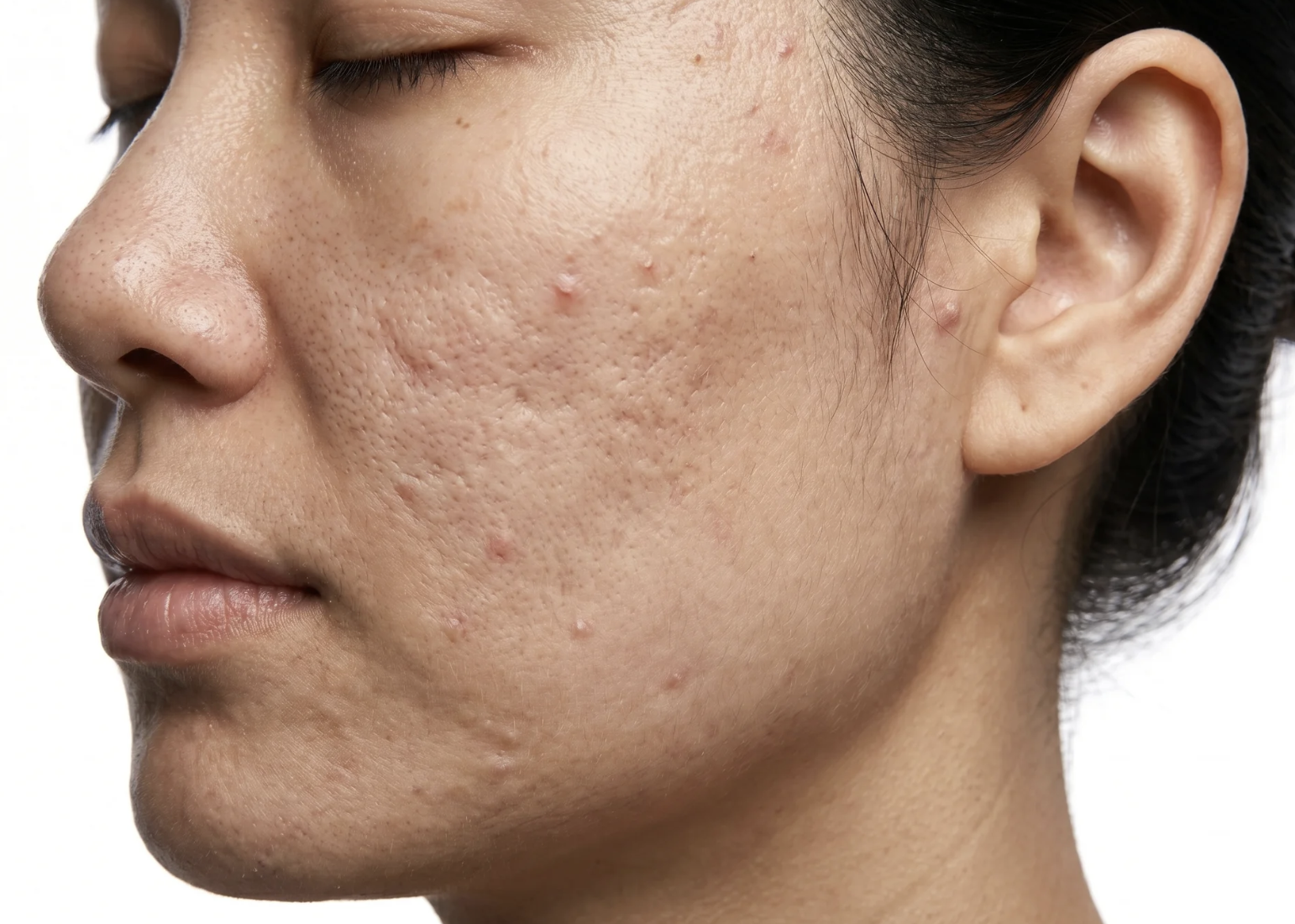
Acne Scar Treatment in Singapore: A Complete Doctor Led Guide To Smoother Skin
Acne scar treatment is not about choosing the strongest laser or the newest device. It is about understanding why the scar is there, how deep it sits, whether it is tethered and what the skin needs in order to rebuild collagen in a controlled way.
This matters because acne scars are rarely just one single scar type. A patient may have rolling scars, boxcar scars, ice pick scars, enlarged pores, post-inflammatory pigmentation, redness and active acne. The best acne scar treatment is therefore not one treatment, but a staged plan that treats the scar from different depths and angles.
At The Clifford Clinic, acne scar treatment is approached as a three-dimensional repair process. The aim is to soften scar depth, improve skin texture, rebuild dermal support, reduce pigmentation and prevent new acne scars from forming. This philosophy is also reflected across related educational resources from Dr Gerard Ee, where acne scar care is presented as a doctor-guided process rather than a fixed package.
What Is Acne Scar Treatment
Acne scar treatment refers to medical treatments that improve the texture, depth, colour and contour changes left behind after acne. These scars form when inflammation damages collagen in the deeper skin and the healing response becomes uneven.
When the infection damages the underlying dermis, depressed scars form. These are called atrophic scars and they include ice pick scars, boxcar scars and rolling scars. When the skin produces too much collagen, raised scars such as hypertrophic scars and keloids can form.
Acne scars are different from acne marks. Brown marks and red marks are usually colour changes caused by inflammation. True acne scars create a change in skin contour, which means the surface catches light unevenly.
This distinction is important because colour and contour need different treatments. Pigmentation may respond to topical brightening agents, pigment lasers like Q-switch or V Beam or vascular lasers. Depressed scars usually need fractional laser, TCA CROSS, microneedle fractional RF and injectable support.
Why Acne Scars Form
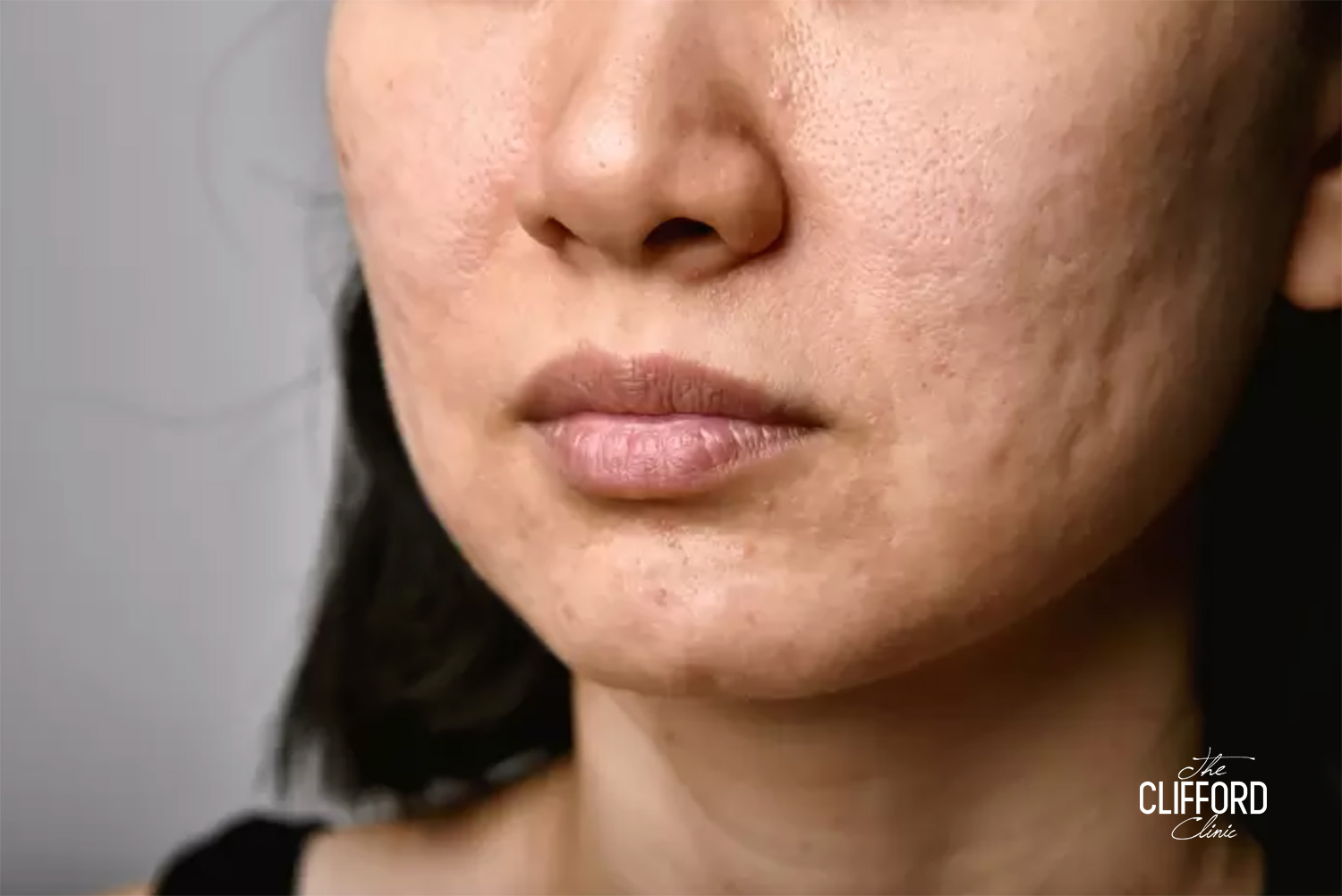
Acne scars form when inflammation reaches the deeper dermis. This is more common with cystic acne, nodular acne, repeated pustules, delayed acne treatment and frequent squeezing of inflamed pimples.
The skin tries to repair itself after acne settles. If the damaged collagen is not replaced evenly, the skin can heal with pits, depressions and shadowing. In some cases, fibrous bands develop under the scar and pull the skin downward.
This is why acne scar treatment should not only focus on the surface. A scar may look like a dent on the outside, but the real problem sits under the skin, within the deep dermis.
Active acne should also be controlled before aggressive scar revision. Treating scars while new, inflamed acne continues is frustrating because new scars can keep forming. A good plan improves old scars while reducing the risk of fresh ones.
A caveat to this is using Secret RF, which is a microneedle fractional RF machine that uses non-insulated RF microneedles. This machine, according to Dr Ee, allows for physicians to not only achieve acne control and stability, but it also improves texture at the same time.
The Main Types Of Acne Scars
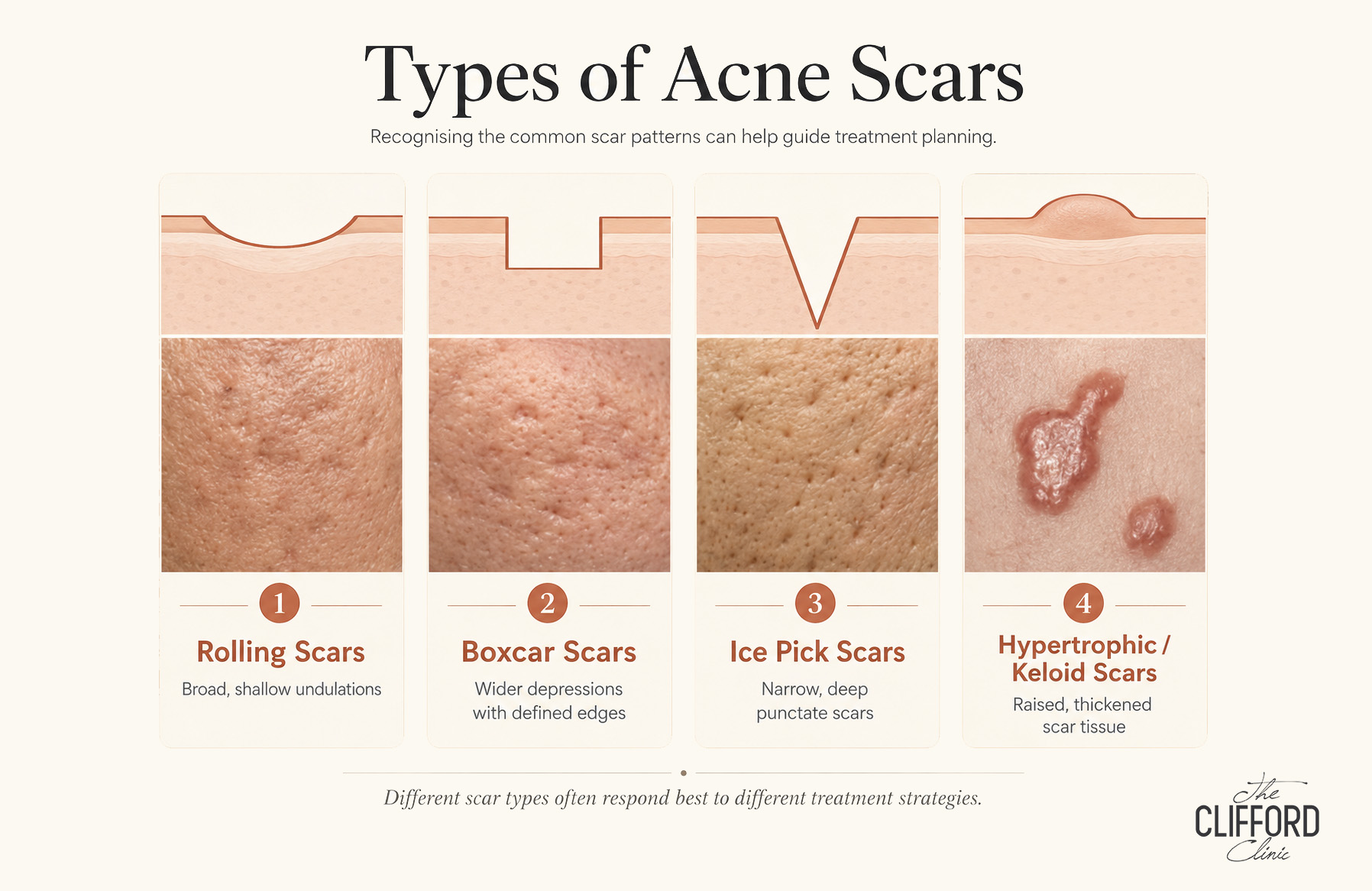
A proper acne scar treatment plan begins with scar typing. The doctor should examine the skin under good lighting, look at the scars from different angles and check whether the scars improve when the skin is stretched.
Ice pick scars are narrow and deep. They often look like small punctures in the skin. Because they extend deeper than they appear, they usually need targeted treatments rather than broad surface treatments alone.
Boxcar scars are wider depressions with more defined edges. Some are shallow and respond well to resurfacing. Others are deeper and need a combination of fractional laser, TCA CROSS, microneedle fractional RF and injectable support.
Rolling scars create soft waves or broad shallow valleys in the skin. They are often caused by anchoring scar fibres under the skin. These scars usually need treatment that works below the surface.
Hypertrophic scars and keloids are raised scars. These are not treated like depressed scars. They may require scar flattening injections, silicone therapy, vascular laser or other scar-specific approaches.
Why One Treatment Is Rarely Enough
The most common mistake in acne scar treatment is assuming that one machine can treat every scar. Different scar types sit at different depths and need different treatment mechanisms.
Fractional CO2 laser can resurface scar edges and improve surface texture. Infini can remodel deeper dermal collagen using insulated microneedle fractional RF. Secret RF can create broader vertical heating using non-insulated microneedle fractional RF. Biostimulators can improve dermal support and skin quality over time.
This is why combination treatment often gives better results. The goal is not to do many treatments for the sake of it. The goal is to choose the right treatment sequence based on the scar pattern.
A patient with mostly ice pick scars may need TCA CROSS and resurfacing. A patient with rolling scars may need cannula-based release and biostimulator support. A patient with texture, pores and acne marks may need Secret RF, Pico laser and pigment control.
Infini For Acne Scar Treatment
Infini is an insulated microneedle fractional radiofrequency treatment. The insulated needles are designed to deliver radiofrequency energy more selectively into the deeper dermis while reducing unnecessary surface heating. This makes it useful when the goal is deep collagen remodelling beneath acne scars.
This is especially relevant for deep acne scars, rolling scars, enlarged pores and skin laxity. The treatment creates controlled coagulation zones inside the skin, which then stimulate collagen remodelling during the healing process. Over time, the scarred area can look smoother and firmer.
Infini is not simply microneedling. It combines needle penetration with radiofrequency energy, which allows heat to be placed at selected depths. This is useful because many depressed acne scars are not purely surface problems.
The Clifford Clinic positions INFINI as a treatment for deep acne scars, skin lifting and rejuvenation. The clinic also notes that deep acne scars involve collagen loss in the dermis, which is why treatments that reach below the epidermis are important.
Why Insulated RF Matters
Insulated microneedles concentrate the energy closer to the intended treatment depth. In practical terms, this can be helpful when a patient needs deeper dermal stimulation while limiting excessive energy delivery along the full needle track.
This does not mean insulated RF is always better. It means it has a specific role. It is often a strong fit for deeper scars, dermal remodelling, collagen stimulation and patients where surface irritation or pigmentation risk needs to be considered carefully.
For Asian skin, this controlled energy delivery can be useful. Many patients in Singapore are prone to post-inflammatory pigmentation after heat, irritation or aggressive resurfacing. A treatment plan should therefore balance scar improvement with safe healing.
Infini, can be particularly valuable when scars need depth-focused remodelling. It may be paired with Secret RF, fractional CO2 laser, Pico laser, TCA CROSS or injectables depending on the scar map.
Secret RF For Acne Scar Treatment
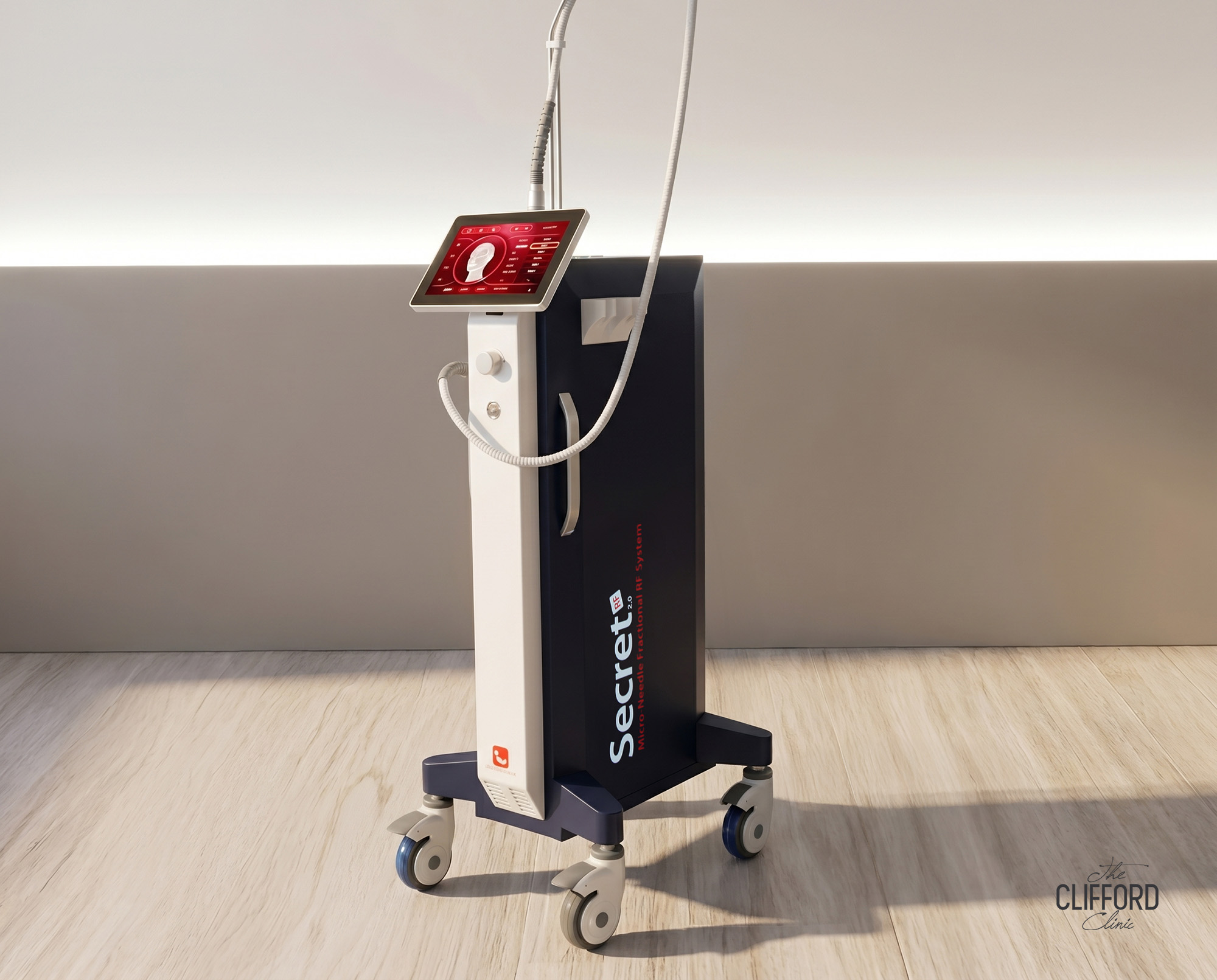
Secret RF is a non-insulated microneedle fractional radiofrequency treatment when used with its non-insulated tip. Non-insulated needles allow energy to distribute along a greater portion of the needle track, creating a broader vertical zone of treatment. This can be helpful for depressed acne scars, pores and overall textural irregularity.
This makes Secret RF different from Infini. Infini is generally more depth-focused because of its insulated microneedles. Secret RF can be more useful when broader resurfacing and texture remodelling are needed.
Secret RF is commonly considered for rolling scars, boxcar scars, ice pick scars, pores, wrinkles and general skin texture. It can also fit well into acne scar treatment when the skin is still acne-prone, because the plan can address scars and skin quality together.
The official Secret RF platform is described as a fractional RF microneedling system that delivers controlled energy at different depths to stimulate and remodel collagen. This depth adjustability is important because acne scars are not all located at the same layer.
Infini Versus Secret RF
Infini and Secret RF should not be viewed as identical treatments. They are both microneedle fractional RF technologies, but their energy delivery patterns differ.
Infini, uses insulated microneedles. This helps focus radiofrequency energy deeper in the dermis. It is often more suitable when the goal is deeper collagen remodelling with less surface heating.
Secret RF can use non-insulated microneedles. This allows energy to spread along the needle track, which can produce broader textural remodelling. It can be useful for scars that need improvement in depth, pores and general skin roughness.
At The Clifford Clinic, Infini and Secret RF are positioned as complementary tools rather than direct replacements for each other. Dr Gerard Ee has observed that some scars respond better when both technologies are used strategically in the same acne scar programme.
Fractional CO2 Laser For Acne Scars
Fractional CO2 laser remains an important acne scar treatment. It works by creating controlled microscopic zones of ablative resurfacing in the skin. As the skin heals, new collagen forms and scar edges become softer.
This treatment is often useful for shallow boxcar scars, rough texture, enlarged pores and surface irregularity. It improves how light reflects from the skin, which can make scars look less obvious in photographs and real-life lighting.
The fractional CO2 laser is more surface intense than microneedle fractional RF. This means downtime can be longer, with redness, swelling, peeling and temporary sensitivity. The treatment settings should be chosen carefully, especially in Asian skin.
It is rarely the whole answer for tethered scars. If a rolling scar is held down by anchoring fibres, laser resurfacing may improve the surface but leave the depression behind. This is why lasers often work best as part of a staged plan.
Pico Laser For Acne Marks And Texture
Pico laser can help with pigmentation, uneven tone, pores and selected textural concerns. It is often used when acne scars are accompanied by brown marks, grey marks or uneven skin colour.
For patients with post-inflammatory pigmentation, Pico laser may improve the colour contrast around acne scars. This can make scars appear less obvious even before deep contour correction is complete.
Pico laser should not be oversold as a cure for every scar. Deep rolling scars, tethered scars and severe boxcar scars often need deeper remodelling or injectable support. Pico laser is best understood as one tool within a broader acne scar treatment strategy.
The Skin Longevity Clinic has useful educational content on Pico laser for pigmentation and acne scar-related concerns. This is helpful for patients who need to understand the difference between treating colour and treating contour.
TCA CROSS For Ice Pick Scars
TCA CROSS is a targeted treatment for selected deep acne scars. It is often used for ice pick scars and narrow, deep boxcar scars. The technique involves applying trichloroacetic acid precisely into the scar to trigger controlled collagen formation.
This is not a full face peel. It is a spot treatment performed on selected scars. Accuracy matters because the treatment should stay inside the scar and avoid unnecessary irritation of the surrounding skin.
TCA CROSS is usually done as a series. The scar gradually remodels as collagen forms over time. It may be combined with fractional laser, Pico laser, Infini, Secret RF or injectables depending on the overall scar pattern.
It is not the best option for broad rolling scars. Rolling scars are usually caused by deeper anchoring fibres and dermal volume loss, which means they need deeper release and support rather than only a focal chemical technique.
Injectables In Acne Scar Treatment
Injectables have become increasingly important in acne scar treatment. They are not only used to fill. In modern scar care, they may also support collagen stimulation, dermal thickening, hydration, repair and structural regeneration.
This is especially useful when scars are depressed because the skin has lost dermal support. A scar may soften with laser, but if the underlying dermis remains thin or unsupported, the shadow may persist.
The injectable category includes hyaluronic acid fillers, polynucleotides, PDRN, Juvelook, Sculptra and Re2O. These products are not the same. Each works differently and should be chosen based on scar type, skin thickness and treatment goals.
Injectables are technique-sensitive. They should be planned by a doctor who understands scar anatomy, vascular anatomy, cannula movement, product behaviour and the risk of unevenness.
Juvelook Scars
Juvelook is a hybrid collagen-stimulating injectable that combines hyaluronic acid with PDLLA. The hyaluronic acid component gives hydration and early support, while the PDLLA component provides gradual collagen stimulation. Juvelook is used for fine lines, skin texture, acne scars and skin quality improvement.
For acne scars, Juvelook can be useful when the goal is to improve shallow depressions, texture, pores and dermal thickness. It is not simply a moisturising skin booster. It belongs more naturally in the hybrid biostimulator category because it supports collagen over time.
Juvelook is particularly interesting for patients who do not want an overfilled appearance. The goal is gradual improvement in skin quality rather than obvious volume change. This makes it suitable for scarred skin that needs support without puffiness.
It may be used after energy-based treatments have started remodelling the scar tissue. Once the scar plane is more responsive, Juvelook can help reinforce dermal quality and soften shallow shadowing.
Sculptra For Acne Scars
Sculpta is a poly-L-lactic acid injectable collagen stimulator. It works gradually by stimulating collagen production and improving skin structure over time. It is better known for facial collagen restoration, but poly-L-lactic acid has also been studied for atrophic acne scarring.
In acne scar treatment, Sculptra can be considered when there is broader dermal thinning, rolling scar shadowing or volume-related depression. It is usually not the first choice for tiny ice pick scars because those need more focal correction.
Sculptra is not a simple filler that instantly lifts every scar. It is a biostimulator. This means improvement develops gradually as collagen forms and matures over weeks to months.
The advantage is that it can improve the quality of the scarred area more globally. When used carefully, it can help thicken the dermis, soften broad depressions and improve how the skin reflects light.
Re2O For Skin Quality And Scar Support
Re2O, sometimes typed as RE20, is an ECM focused injectable skinbooster. It is designed to support hydration, elasticity and skin quality by working within the dermis and the extracellular matrix environment. The Clifford Clinic describes Re2O Skinbooster as an injectable biorevitalizer that delivers a high concentration of hyaluronic acid into the dermis.
ECM focused skinboosters are interesting in acne scar treatment because scarred skin is often not only dented. It may also be thin, dull, inflamed, dehydrated and slow to recover after procedures.
Re2O should be positioned as a skin quality and repair support treatment rather than a replacement for RF, laser or scar release. It may help the skin look healthier, more elastic and more resilient during a longer acne scar treatment journey.
For suitable patients, Re2O can be layered between stronger procedures. This can be helpful when the skin barrier is sensitive, recovery is slow or the patient needs better skin quality before the next collagen remodelling session.
Biostimulators Versus Fillers
Traditional hyaluronic acid fillers provide volume and lift. Biostimulators encourage the skin to produce new collagen or improve its structural environment. Both can have a role in acne scar treatment, but they are not interchangeable.
Juvelook is useful when hydration and collagen stimulation are both desired. Sculptra is useful when broader collagen stimulation and structural support are needed. Re2O is useful when skin quality, elasticity and dermal environment are priorities.
The best injectable choice depends on the scar pattern. A broad rolling scar may need cannula based release and deeper biostimulation. A shallow textural scar may need Juvelook. Thin, tired and reactive skin may benefit from Re2O as supportive care.
The goal should not be to fill every dent. The better goal is to rebuild scarred skin in layers so that the surface looks smoother, firmer and more natural under normal lighting.
Subcision and Cannula-Based Scar Release
Subcision is traditionally used for tethered acne scars. A needle or cannula is passed under the scar to release fibrous bands that pull the skin down. This can immediately loosen the scar and trigger collagen remodelling.
However, not every patient needs a separate sharp needle subcision session. In Dr Gerard Ee’s expert opinion, selected tethered scars can be addressed through the process of cannula-based biostimulator injection, where the cannula naturally separates anchoring scar fibres as it moves through the scar plane.
This is not the same as ignoring subcision. It means the release and the biostimulator placement happen together. The cannula creates a gentle subcision effect while the injectable supports the released space and encourages dermal repair.
This approach can be especially useful when the patient has rolling scars, shallow tethering, thin dermis or a need for collagen support. It can also reduce the need for overly aggressive standalone subcision in selected cases.
Why Specific Subcision May Not Always Be Needed
A specific subcision session is useful when scars are strongly tethered and need deliberate release. Yet in many acne scar patients, the treatment goal is not only to cut fibres. It is to release, support and remodel the scarred plane.
When a cannula is used to deliver Juvelook, Sculptra, Re2O or other suitable biostimulators, the cannula can pass through the same fibrotic planes that hold down rolling scars. This movement can loosen scar anchors while placing regenerative support where the skin needs it.
The benefit is efficiency. The scar is mechanically freed and biologically supported in the same procedure. The result can be smoother improvement without treating subcision as a separate ritual every time.
This should still be individualised. Dense tethering, severe rolling scars and deep bound-down scars may still need more formal subcision. The point is that subcision should be a principle, not merely a named procedure.
A Modern Acne Scar Treatment Sequence
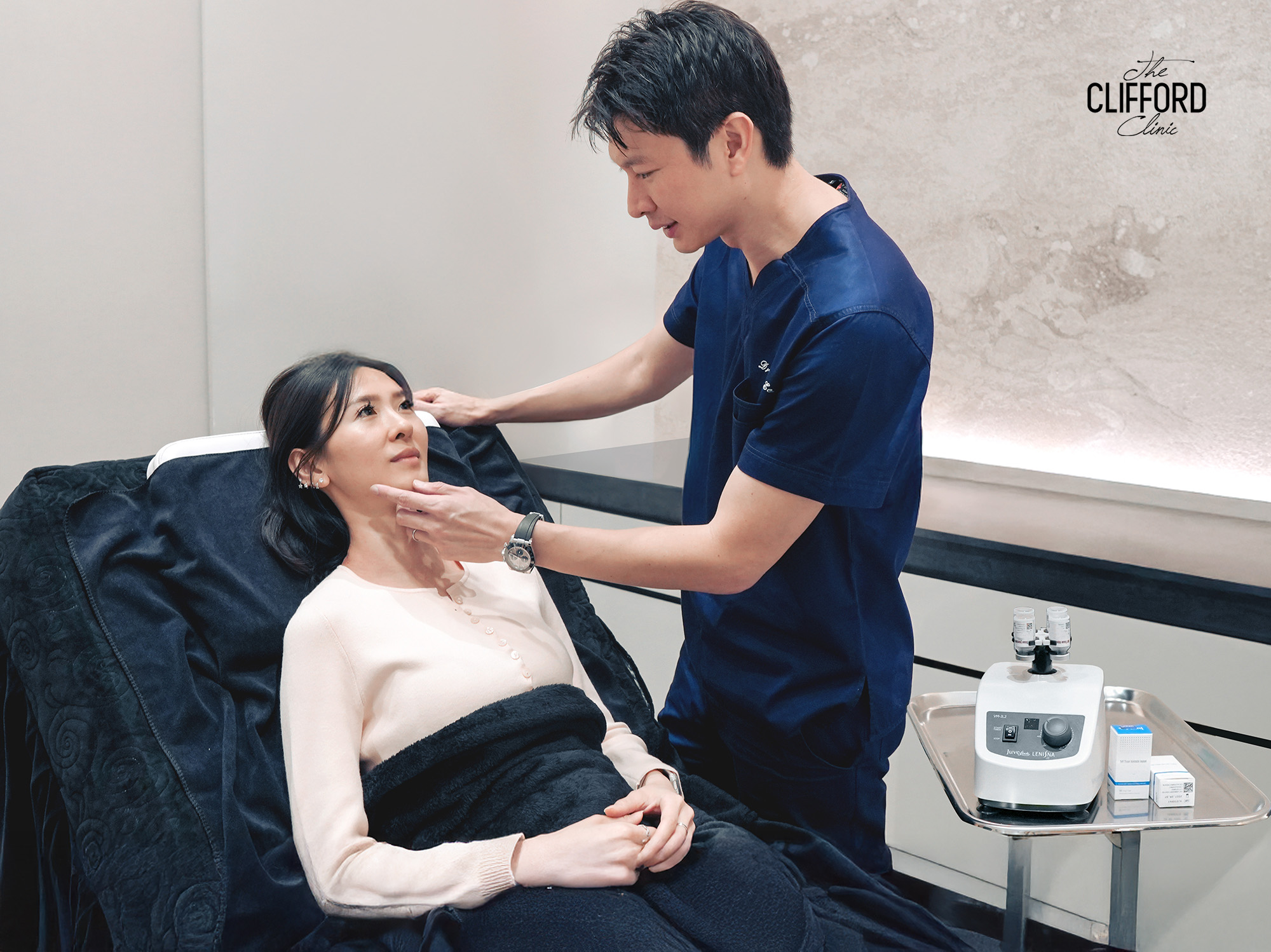
A good acne scar treatment sequence begins with diagnosis. The doctor maps scar types, checks for active acne, assesses pigmentation risk and reviews previous treatments.
The first stage is acne control. This may involve medical skincare, acne medications, oil control, AGNES RF, lasers or other doctor-directed treatment. Preventing new scars is just as important as improving old ones.
The second stage is structural treatment. Infini, Secret RF, fractional CO2 laser, TCA CROSS, cannula release and biostimulators may be selected based on scar depth. The goal is to remodel collagen and reduce scar shadowing.
The third stage is refinement. Pico laser, skinboosters, vascular lasers, pigment control and maintenance skincare can improve tone, smoothness and skin quality. This is where the skin starts to look healthier overall.
Acne Scar Treatment For Asian Skin
Asian skin can respond very well to acne scar treatment. The important point is to treat it carefully, because pigmentation risk is higher when the skin is overheated, irritated or treated too aggressively.
This does not mean treatment should be weak. It means treatment should be precise. Energy settings, treatment intervals, needle depth, aftercare and product choice should be customised.
Insulated microneedle RF such as Infini,can be useful when deeper collagen remodelling is needed with less unnecessary surface heat. Non insulated microneedle RF such as Secret RF can be useful when broader textural remodelling is needed and the treatment is planned carefully.
Sunscreen, gentle skincare and pigment control matter after every procedure. A strong acne scar plan can be undermined if the skin becomes inflamed after treatment and develops new pigmentation.
Downtime After Acne Scar Treatment
Downtime depends on the treatment. Pico laser may cause mild redness and sensitivity. Infini and Secret RF may cause swelling, redness, pinpoint marks and temporary roughness. Fractional CO2 laser can involve peeling, crusting and several days of visible recovery.
Injectables can cause swelling, bruising, small bumps or tenderness. Cannula-based scar release can produce bruising and swelling, although this varies depending on technique, scar density and individual healing.
TCA CROSS causes treated scars to darken, scab and shed gradually. Patients should avoid picking at the treated areas because premature removal of scabs can increase pigmentation and worsen texture.
Recovery is part of the treatment. Gentle cleansing, moisturiser, sunscreen and doctor-directed aftercare are usually more useful than complicated skincare routines during the early healing phase.
What Results Can Patients Expect
Acne scar treatment can improve scars, but it rarely makes every scar disappear completely. A realistic goal is smoother texture, softer depressions, less shadowing, refined pores and healthier-looking skin.
Results are gradual because collagen remodelling takes time. Some changes may appear once swelling settles, but greater improvement usually develops over weeks to months.
Patients with shallow boxcar scars may respond faster than patients with deep mixed scars. Rolling scars may need release and support before surface treatments can show their full benefit.
Progress should be tracked with consistent photos. Lighting, camera angle and facial expression can change how scars look. Good documentation makes the treatment journey more honest and useful.
How Many Sessions Are Needed
Most patients need a series. Mild acne marks may need fewer sessions, while deep mixed scars often require a longer staged plan.
Infini, Secret RF, fractional CO2 laser are usually performed over multiple sessions because collagen remodelling is cumulative. TCA CROSS also usually requires a series because each treatment remodels selected scars gradually.
Injectables may be performed as a course or staged between energy-based treatments. Juvelook, Sculptra and Re2O are usually planned based on skin quality, scar depth and the amount of dermal support needed.
The plan should be reviewed after key milestones. If scars respond well, the strategy can continue. If certain scars remain stubborn, the doctor may adjust the method rather than simply repeating the same treatment.
Choosing The Right Acne Scar Clinic In Singapore
A good acne scar clinic should begin with scar diagnosis. The consultation should identify scar type, scar depth, tethering, active acne, pigmentation, skin sensitivity and downtime tolerance.
The doctor should explain why each treatment is recommended. A patient with rolling scars should understand why release or biostimulator support may be needed. A patient with ice pick scars should understand why TCA CROSS may be considered.
Be careful with packages that promise one device for every scar. Acne scars are three-dimensional. They do not all sit at the same layer, and they do not all respond to the same treatment.
A strong clinic should offer combination planning, aftercare, progress review and realistic expectations. The best acne scar treatment is usually not the most aggressive plan. It is the most appropriate plan.
Why Choose The Clifford Clinic For Acne Scar Treatment
The Clifford Clinic offers a broad acne scar treatment approach that includes Infini, Secret RF, fractional laser, Pico laser, subcision principles, injectables, biostimulators and acne control. This allows treatment to be matched to scar type instead of forcing every patient into one standard protocol.
Dr Gerard Ee’s approach focuses on scar classification, combination planning and long-term collagen remodelling. The emphasis is on treating acne scars as structural tissue changes rather than simple surface marks.
The clinic’s use of both insulated RF and non-insulated RF is important. Infini and Secret RF can be paired because they deliver radiofrequency energy differently. This allows deeper remodelling and broader texture refinement to be planned within the same acne scar journey.
Injectables such as Juvelook, Sculptra and Re2O can further support the treatment plan. When placed with the right technique, they can improve dermal quality, stimulate collagen and help support scars that have been softened by RF or laser.
FAQ
What is the best acne scar treatment
The most effective acne scar treatment depends on the scar type. Ice pick scars may need TCA CROSS. Rolling scars may need cannula based release, RF and biostimulators. Boxcar scars may need fractional CO2 laser, Infini, Secret RF or resurfacing.
Is Infini good for acne scars
Infini can be useful for deep acne scars because it uses insulated microneedle fractional RF to deliver energy into the dermis. This supports collagen remodelling under the scar and may be useful for deeper depressions, pores and skin laxity.
Is Secret RF good for acne scars
Secret RF can be useful for depressed acne scars, pores and uneven texture. With non insulated microneedles, it can create a broader vertical zone of heating, which may help with textural remodelling and shallow to moderate depressed scars.
Which is better, Infini or Secret RF
Neither is universally better. Infini is often stronger for deeper dermal remodelling because of insulated microneedles. Secret RF can be useful for broader textural remodelling because of non insulated microneedle energy delivery.
Can Juvelook improve acne scars
Juvelook can help selected acne scars by improving hydration, dermal thickness and collagen stimulation. It is best for shallow depressions, pores and skin quality rather than very deep ice pick scars.
Can Sculptra improve acne scars
Sculptra may help selected depressed acne scars, especially rolling scars and broader atrophic scars linked to dermal thinning or volume loss. It works gradually by stimulating collagen rather than instantly filling every scar.
What is Re2O used for in acne scar treatment
Re2O can support skin hydration, elasticity and dermal quality. It is not a replacement for RF, laser or scar release, but it may help the skin recover and behave better during a longer scar treatment journey.
Is subcision always needed for rolling scars
Formal subcision is not always needed for every rolling scar. In selected cases, cannula-based biostimulator injection can naturally release anchoring scar fibres while placing collagen stimulating support into the scarred plane.
Can acne scars disappear completely
Acne scars can improve significantly, but complete removal is uncommon. The goal is smoother skin, less shadowing, better texture and healthier skin quality.
Is acne scar treatment safe for Asian skin
Acne scar treatment can be safe for Asian skin when planned carefully. Settings, depth, product choice, aftercare and treatment spacing should be customised to reduce pigmentation risk and support steady healing.
Conclusion
Acne scar treatment works best when it is planned as a structured journey. The skin must be assessed, acne must be controlled, scar types must be mapped and treatments must be chosen according to depth and tethering.
Infini and Secret RF are valuable because they treat scars from different RF angles. Infini uses insulated microneedle fractional RF for deeper controlled collagen remodelling. Secret RF uses non-insulated microneedle fractional RF when broader vertical remodelling and texture improvement are needed.
Injectables can add another layer of improvement. Juvelook can support hydration and collagen stimulation. Sculptra can provide gradual structural collagen support. Re2O can improve skin quality and the dermal environment during recovery.
In Dr Gerard Ee’s expert opinion, subcision should be understood as a scar release principle rather than only a standalone procedure. In selected patients, the cannula used during biostimulator injection can naturally subcise anchoring scar fibres while placing regenerative support where the scar needs it most.
The best acne scar treatment is not one machine. It is the right combination, in the right order, for the right patient.
References
- The Clifford Clinic. Acne Scars Singapore Patients Can Improve Safely With Combination Treatment.
- The Clifford Clinic. Secret RF Microneedling in Singapore.
- The Clifford Clinic. INFINI Acne Scar Treatment in Singapore.
- The Clifford Clinic. Insulated vs Non-Insulated Microneedle Fractional RF.
- The Clifford Clinic. Re2O Skinbooster in Singapore.
- The Clifford Clinic. Acne Scar Treatment Using Subcision, Rejuran And Biostimulator Fillers.
- Dr Gerard Ee. Acne Scar Removal Treatment in Singapore.
- Dr Gerard Ee. Subcision For Acne Scars.
- Dr Rachel Ho. Evidence-Based Aesthetic Medicine And Skin Longevity.
- The Skin Longevity Clinic. Skin Longevity And Advanced Skin Treatments.
- Cutera. Secret RF Product Information.
- Cutera. Secret RF Product Brochure And Treatment Information.
- VGA Asia. INFINI Radiofrequency Microneedling Brochure.
- Juvelook. Advanced Hybrid Collagen Stimulator.
- Sculptra. Poly L Lactic Acid Injectable Collagen Stimulator.
- Sadick N S. Injectable Poly L Lactic Acid For Acne Scars.
- Zhou C. Poly L Lactic Acid Combined With Fractional CO2 Laser For Acne Scars.