
Radiesse Filler Singapore: Calcium Hydroxylapatite (CaHA) Collagen Stimulator
Most dermal fillers add volume and nothing more. Radiesse filler does two things. It lifts on the day of treatment, and over the following months it stimulates the skin to produce its own collagen. At The Clifford Clinic in Singapore, Radiesse is used in two forms. At full strength it rebuilds a soft jawline, a short chin, flat cheeks or hands that have lost volume. Heavily diluted, it acts as a collagen stimulator for crepey, loose skin on the lower face, neck and arms. Radiesse costs $1,400 per syringe before GST, review appointment included. The hyperdilute skin-tightening protocol is $1,800 per session, or $3,000 for two sessions, before GST.
Written by Dr Gerard Ee, MBBS (St George’s, University of London), MRCS (Edinburgh), Postgraduate Diploma in Practical Dermatology (Cardiff). Founder and Medical Director, The Clifford Clinic, 50 Raffles Place, Singapore. Practising aesthetic medicine since 2012. Last medically reviewed and updated: 2 November 2026.
Radiesse in Singapore: key points
- Radiesse lifts on the day, then stimulates the skin to grow its own collagen, elastin and blood vessels around tiny ceramic beads. New collagen starts at week 4 and peaks at month 4.
- Full strength, it shapes the jawline, chin, cheeks, nose and hands. Heavily diluted, it tightens crepey skin on the lower face, neck, chest and arms without adding volume.
- Results last 12 to 18 months on average, sometimes 24 or more.
- It is the only ceramic collagen stimulator. Unlike Sculptra (PLLA) and Ellanse (PCL), it does not work by provoking a foreign-body reaction.
- It cannot be dissolved, so it is placed deep and never in the lips, between the brows or around the eyes. Across 5,081 reviewed facial treatments, side effects occurred in 3%, almost all small lumps.
- The Clifford Clinic price: $1,400 per syringe (review included), or $1,800 per hyperdilute skin-tightening session, $3,000 for two, before GST.
- Nineteen peer-reviewed papers, checked on PubMed, back this page. Who funded them is disclosed below.
Book a Radiesse consultation at The Clifford Clinic, 50 Raffles Place.
Call (65) 6532 2400 or WhatsApp (65) 8318 6332
What is Radiesse? A filler and a collagen biostimulator in one
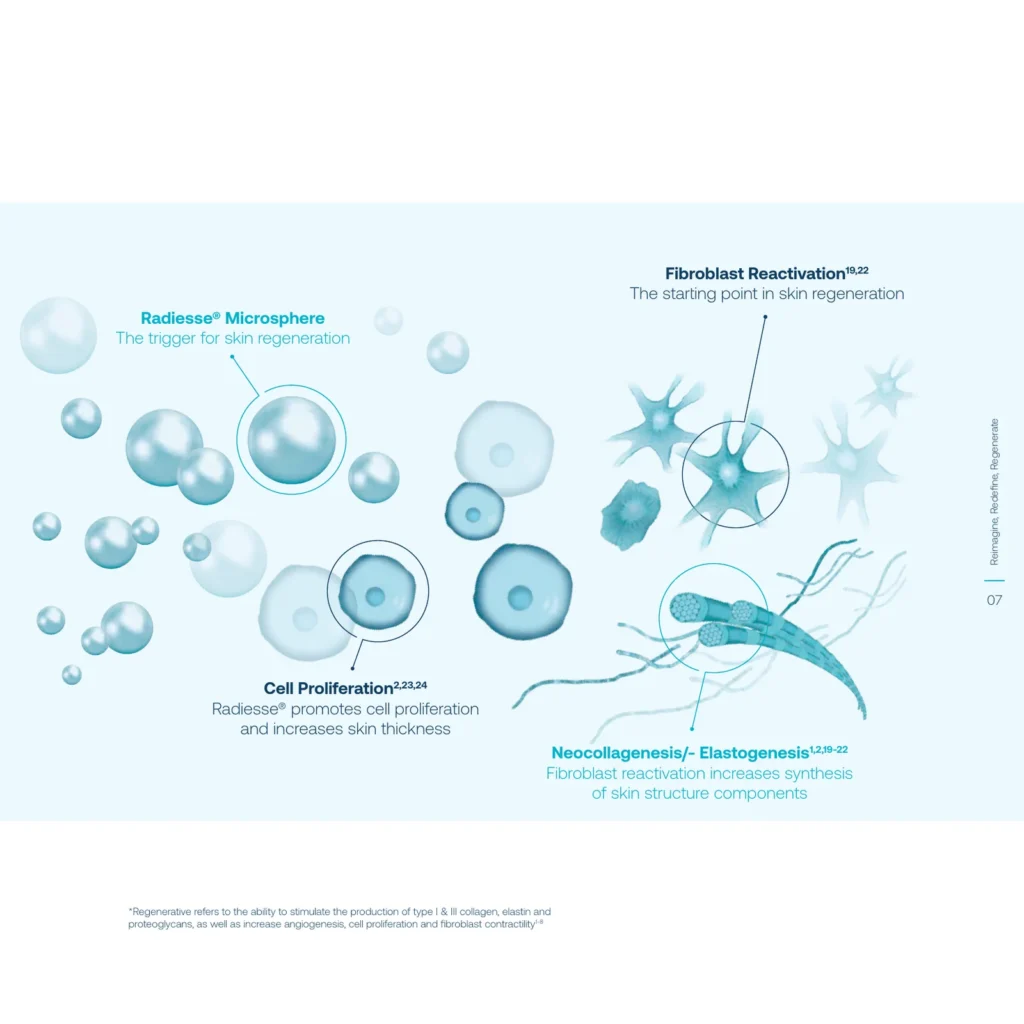
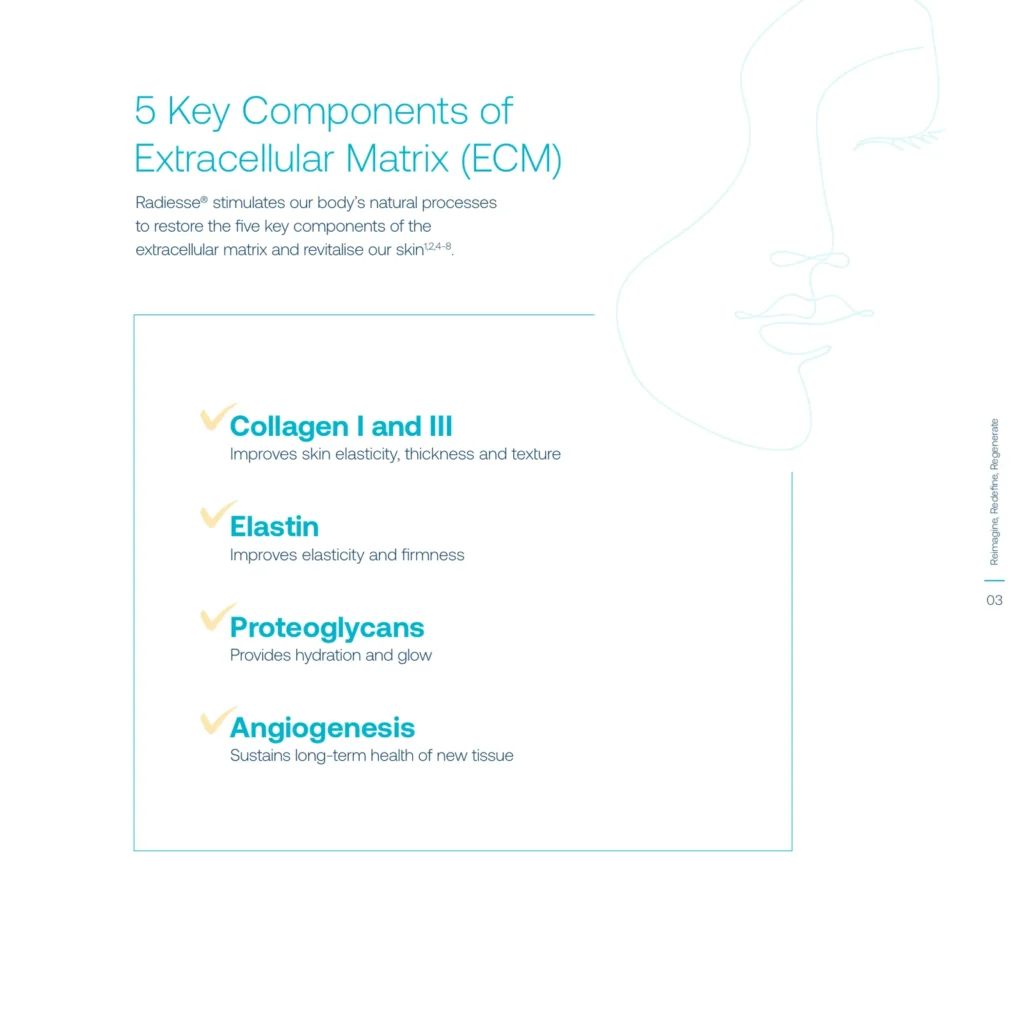
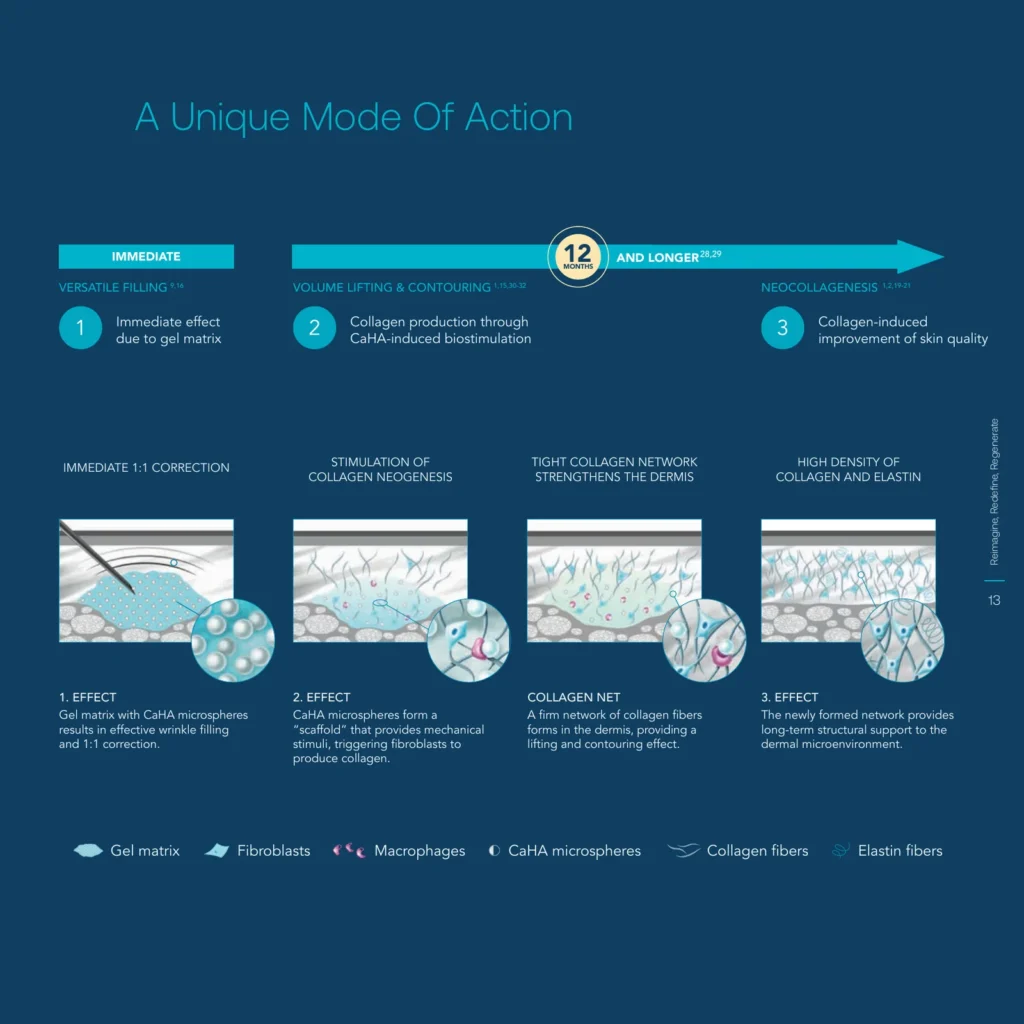
Radiesse is a smooth gel carrying millions of microscopic ceramic microspheres. The microspheres are calcium hydroxylapatite (CaHA), the mineral that forms bone and teeth, each about half the width of a human hair. The gel makes up 70% of the product and the microspheres 30%.11 Because CaHA is a mineral the body already contains, it is well tolerated and is broken down completely over time.1,2 Radiesse is the only injectable collagen stimulator made of a ceramic. Sculptra, made of poly-L-lactic acid (PLLA), and Ellanse, made of polycaprolactone (PCL), are synthetic polymers.11,14
The two effects occur in sequence. On the day of treatment, the gel provides the visible lift. Over the following two to three months the gel is absorbed, leaving the microspheres in place as a scaffold. Fibroblasts, the cells that produce collagen, attach to that scaffold and lay down new collagen around each microsphere.1 A hyaluronic acid (HA) filler cannot do this, because HA adds volume only while the gel itself remains in the tissue.2 By 12 months, imaging shows almost no Radiesse remaining, yet the improvement persists, because the volume is by then provided by the patient’s own collagen.2 MRI has tracked the product for up to 30 months, with the skin still thicker after the product has cleared.11
Radiesse has held US FDA approval since 2006 for facial folds and for HIV-related facial fat loss. The European label also covers the jawline, chin, cheeks, temples, nasal bridge and hands. More than five million syringes had been used worldwide by 2013.2
Radiesse treatment areas for the jawline, chin, cheeks, hands and neck
Full-strength Radiesse, for structure and shape
- Jawline and jowls. Radiesse is a firm filler, so it holds a straight line along the jaw and fills the small hollow that forms in front of a jowl. Technique guidance places it deep, with up to 0.5 ml at the angle of the jaw.2
- Chin. Lengthening the chin slightly makes the whole face appear slimmer and more V-shaped, and draws in some of the loose skin beneath the jaw.
- Cheeks. Placed deep on the bone, Radiesse restores the structural support the cheeks lose with age, so the mid-face lifts without an overfilled appearance.
- Hands. Radiesse is one of the few fillers with a formal licence for the backs of the hands, where it softens the appearance of tendons and veins. For hands that have lost skin quality rather than volume, Profhilo or an HA filler may be suggested instead, as set out on the hand rejuvenation page.
- Nose. Radiesse holds a sharp line on the nasal bridge, but it cannot be dissolved, so it is reserved for patients who have already had HA nose filler, are satisfied with the shape and want a longer-lasting result. See nose fillers in Singapore.
Hyperdilute Radiesse, for skin quality and tightening
- Lower face and jawline, where a thin layer under the skin treats mild sagging and crepey texture.
- Neck, for horizontal neck lines and loose, thin skin.
- Décolletage, for sun-damaged chest skin.
- Upper arms, for laxity of the inner arm.
- Backs of the hands, for thin, crepey skin.
Where Radiesse is not used. The product is not placed between the eyebrows, around the eyes or in the lips. Every major review and consensus group advises against these three areas because the skin there is thin and mobile, which raises the risk of nodules and of blocking a blood vessel.2,4,8
Radiesse vs Sculptra vs Ellanse vs hyaluronic acid
| Radiesse (CaHA) | Sculptra (PLLA) | Ellanse (PCL) | Hyaluronic acid | |
|---|---|---|---|---|
| Lift on the day | Yes | No, builds over months | Yes | Yes |
| Collagen stimulation | Yes | Yes | Yes | Minimal |
| How long it lasts | 12 to 18 months, some to 241,2,8 | About 2 years | 1 to 4 years by formulation | 6 to 18 months |
| Can it be dissolved? | No | No | No | Yes, with hyaluronidase |
| Sessions | Usually 1 for volume, 1 to 3 in year one for hyperdilute tightening4 | 2 to 3 | Usually 1 | 1 |
| Price at Clifford | $1,400 per syringe | See PLLA page | $1,400 per syringe | See dermal fillers page |
Radiesse suits patients who want a visible change on the day of treatment and continued improvement over the following months. Sculptra suits patients who prefer a gradual change with no immediate difference. Ellanse lasts longest and is covered on the PCL collagen stimulating filler page. Where reversibility matters most, such as a first nose filler or the under-eye area, hyaluronic acid remains the appropriate choice.
Book a Radiesse consultation at The Clifford Clinic, 50 Raffles Place.
Call (65) 6532 2400 or WhatsApp (65) 8318 6332
Radiesse vs Sculptra on particle shape and inflammation
Both products stimulate the skin to produce collagen, but through different pathways. Under an electron microscope, Radiesse microspheres are smooth, round and of roughly uniform size. Sculptra particles are irregular flakes ranging from 2 to 150 microns. In a 2024 laboratory study, only 8% of Radiesse particles were small enough for immune cells to engulf, compared with 46% of Sculptra particles.12
The particle shape matters because it determines how much inflammation each material provokes. A 2025 review describes a spectrum. Polymer stimulators such as PLLA and PCL act partly by provoking a foreign-body reaction, and the body walls the particles off with collagen. Ceramic CaHA does not rely on that inflammation. Fibroblasts attach directly to the smooth microspheres and produce collagen, and the result is described as a thicker, more elastic dermis with a better blood supply.14 In a split-side study in which one arm received hyperdilute Radiesse and the other Sculptra, the Radiesse arm developed many thick new elastin bands with fewer immune cells at the injection site, whereas the Sculptra arm developed a single elastin fibre.11,15
The Clifford Clinic uses both products and selects by indication. Radiesse is chosen where an immediate lift plus firmer, better-supplied skin is wanted, as on the jawline, neck and hands. PLLA is chosen where a slow build of volume alone suits the patient better. Most of this comparison research is funded by the manufacturer or conducted in the laboratory, and head-to-head trials in patients remain small.
How Radiesse treatment works at The Clifford Clinic
- Assessment. The doctor identifies which areas of the face have lost structural volume and which have lost skin quality alone. The two problems call for different strengths of Radiesse, so this step determines the treatment plan.
- Preparation. Numbing cream is applied. Radiesse is mixed with lidocaine in the syringe just before injection, a step the US FDA cleared in 2009.2 For skin tightening it is diluted further with saline, as described in the dilution section below.
- Injection. Most areas are treated with a blunt-tipped cannula rather than a sharp needle. Full-strength product is placed deep, on the bone or just beneath the deepest layer of the skin. Hyperdilute product is fanned out as a thin, even sheet beneath the skin.4,8
- Massage. The area is massaged firmly immediately after injection to distribute the product evenly. This is the single most important step in preventing nodules.4,8
- Review. A review appointment is included. For hyperdilute treatment the useful review is three to four months later, when the new collagen is at its peak.4
The whole appointment takes 30 to 45 minutes. Most patients return to work the same day.
Hyperdilute Radiesse for skin tightening and what the dilution ratios mean
The dilution ratio describes how widely the microspheres are spread. Diluted Radiesse is 1 to 1, meaning 1.5 ml of product mixed with 1.5 ml of saline and lidocaine. Hyperdiluted Radiesse is 1 to 2 or thinner.4,8 At those dilutions the gel disperses almost completely, so there is no lift on the day. The microspheres are distributed thinly beneath the skin, and the whole effect comes from the collagen that forms around them.8
Two international consensus groups have published area-by-area ratios, which The Clifford Clinic follows.4,8
| Area | Dilution | Notes |
|---|---|---|
| Lower face | 1 to 1 (up to 1 to 2 for thin skin) | 1.5 ml per side |
| Neck | Between 1 to 2 and 1 to 4 | 1 to 1 may be used in thicker or Asian skin4 |
| Décolletage | Between 1 to 2 and 1 to 4 | 1 to 4 for more sun damage |
| Upper arms | 1 to 2 (1 to 1 for thicker skin) | about 3 ml of product per arm |
| Hands | 1 to 2 | cannula only6 |
Age also guides the dilution. A 2023 series of 50 patients used 1 to 4 for patients in their thirties as prevention, between 1 to 2 and 1 to 4 for ages 40 to 60, and 1 to 1 or 1 to 2 over 60, in three sessions a month apart. Skin thickness, firmness and wrinkles improved in 95% of the youngest group, 80% of the middle group and 70% of the over-60s, with no significant side effects.6
Why 1 to 1 is preferred for the face. When dilutions were compared under the microscope, 1 to 1 produced the most collagen, roughly 650,000 fibres against 250,000 in untreated skin, a 160% increase. Even 1 to 6 produced more collagen than untreated skin.11,16 Thinner dilutions spread further, about 9 mm sideways at 1 to 1 versus 17 mm at 1 to 2 in a cadaver study, and flow more readily through the tissue, so they are used for thin skin and for large areas such as the neck and arms.11
How many sessions are needed. Usually one to three sessions in the first year, one to two months apart, followed by a top-up every 12 to 18 months.4,8
Book a Radiesse consultation at The Clifford Clinic, 50 Raffles Place.
Call (65) 6532 2400 or WhatsApp (65) 8318 6332
What the published evidence shows for Radiesse
Every claim on this page is drawn from the studies listed below. Eleven of the fourteen primary papers were funded by, or written by consultants or employees of, the manufacturer (Merz). The independent papers are Jacovella 2008, Massidda 2023 and Kadouch 2017. Diluted and hyperdiluted use is off-label in every country where these papers were written.
New collagen, elastin and blood vessels, measured under the microscope. In a randomised split-face study of 19 women aged 35 to 45, one side of the face and neck received Radiesse at 1 to 2 and the other received saline. Over 12 months, collagen type I rose from 0.9 to 4.4 on the study’s scale, collagen type III from 1.5 to 5.7, elastin from 1 to 5.5, and the marker for new blood vessels from 0.1 to 5.4. Marionette lines and neck laxity were measurably improved at 15 months. The product itself had cleared by four months in all but one patient, so the lasting result is the patient’s own collagen.7
Radiesse against hyaluronic acid in the same face. When one side of the face received Radiesse and the other an HA filler, the Radiesse side showed 32% more collagen type I, 18% more elastin and twice the new-vessel score at nine months.17
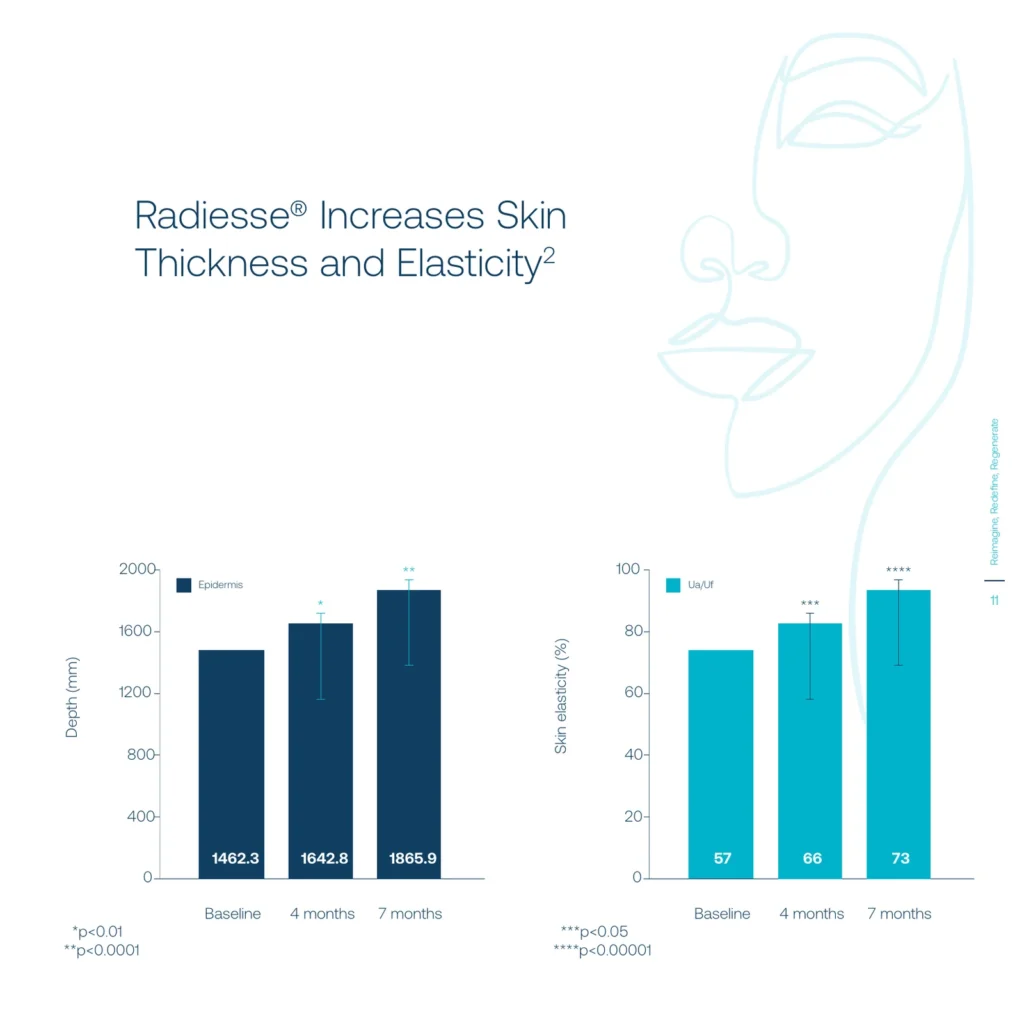
Neck and chest. Two diluted treatments increased dermal thickness on ultrasound by 24% at seven months (1,462 to 1,866 microns) and improved skin elasticity on a Cutometer by 25%.18 In a separate biopsy study of 15 patients, elastin rose by 29% to 179% and proteoglycans, the molecules that hold water in the skin, rose by an average of 76% at six months.19
The timeline of collagen formation. New collagen appears from week four, peaks around month four and stabilises by month nine.4
How long Radiesse lasts. In the US approval trial, 40% of nasolabial folds remained improved at least 30 months after the last treatment, with no late nodules, granulomas or infections in patients followed for up to 39 months.2 Reviews put the average duration at 12 to 18 months, with some results lasting 24 months.1,2,8
Upper arms in Singapore patients. A 2021 Singapore pilot treated 12 women with microfocused ultrasound followed by Radiesse at 1 to 1 or 1 to 2 beneath the skin of the upper arms. Skin firmness improved on the Cutometer from 0.515 mm to 0.433 mm at 24 weeks, and the arm-laxity grade moved from “moderate” (2.9) towards “mild” (2.1) after one session. Bruising was common (92%) and resolved within a week.5
Acne scars. Radiesse lifts rolling, saucer-shaped scars, whereas narrow ice-pick scars do not respond because they are too deep and narrow for a filler to support from beneath.10 In a pilot of 10 patients, ultrasound followed by 1 to 1 Radiesse beneath the scars halved the Goodman scar score, from 7.6 to 3.8, at 90 days, with nine of ten patients very satisfied and no side effects.3 At The Clifford Clinic, Radiesse is used for rolling scars alone or immediately after subcision, once the scar has been released from the fibrous tissue tethering it. See the acne scar treatment page.
Combining Radiesse with HIFU or Thermage
Energy devices and Radiesse act on different layers of the skin, so the two are often combined. The strongest published data use microfocused ultrasound with visualisation (MFU-V). In a 2024 randomised pilot of 12 women, performing the ultrasound first and the 1 to 2 Radiesse six weeks later increased elastin coverage in the skin by 143%, against 63% when the order was reversed, and the ultrasound-first group rated themselves as looking four years younger at day 120.9 The authors concluded that both sequences are effective and that ultrasound first is superior.9
The Clifford Clinic does not use MFU-V. Its skin-tightening devices are high-intensity focused ultrasound (HIFU, Tightan 2) and Thermage FLX. For patients with both loose and thin skin, the doctor may schedule the HIFU or Thermage first and the hyperdilute Radiesse about six weeks later, following the published sequence. The figures above come from MFU-V studies, and the same results are not claimed for other devices.
How long does Radiesse last and when do results show
- Day one. Full-strength Radiesse gives an immediate lift from the gel. Hyperdilute treatment shows little change on the day.
- Weeks one to two. Swelling and any bruising settle.
- Month one. Collagen production begins.4
- Months three to four. Collagen production peaks, and the review appointment falls in this window.4
- Month nine. The result is stable.4
- At 12 to 18 months. The average result reaches the end of its duration. A small top-up at month 12, about half the original amount, can extend the result towards 24 months.1,2
Radiesse side effects, lumps and why it cannot be dissolved
What to expect. Swelling and redness can last up to five days, and bruising occurs in about one in twenty patients with full-strength product.1 Bruising is more common when hyperdilute product is spread over a wide area. In the Singapore arm study, 92% of patients bruised, all mildly.5
Lumps. Nodules form when Radiesse is placed too superficially or in a highly mobile part of the face. A review of 21 studies covering 5,081 facial treatments in 2,779 patients found side effects in 3%, and 96% of those were nodules. The rate was 9.4% in the lips but 0.3% in the nasolabial folds, and 45% of all nodules were in mobile areas. Avoiding the lips and eye area reduces the expected nodule rate to about 0.6%. No infections, allergic reactions or granulomas were recorded in those studies.13 For these reasons the product is injected deep, kept away from the lips and eyes, diluted for thin skin and massaged after every treatment. An early nodule is treated with saline and massage, and a persistent one with a steroid injection.8
Blocked blood vessel. Vascular occlusion is the rarest and most serious filler complication, and because Radiesse cannot be dissolved with hyaluronidase, prevention by technique matters more than with HA. No vessel blockage has been reported with diluted or hyperdiluted Radiesse to date.4 After any filler, severe or worsening pain, pale or blotchy skin, or any change in vision requires urgent medical review. The Clifford Clinic has a hyperbaric oxygen chamber on site to support the skin while blood flow is restored.
Granulomas. None were recorded in the large studies above,2,13 although isolated case reports exist. Under the microscope CaHA causes little inflammation and no true foreign-body reaction, and what is reported as a “granuloma” is usually product that has accumulated through technique.11,14
Who should not have Radiesse. Radiesse is not suitable for patients with an active skin infection at the site, a tendency to keloid scars, a connective-tissue disease or a serious bleeding disorder, for patients who are pregnant or breastfeeding, or for anyone who would be unhappy with a result that cannot be reversed quickly.1
Radiesse price in Singapore
| Treatment | Price |
|---|---|
| Radiesse, per 1.5 ml syringe (jawline, chin, cheek, nose, hands) | $1,400 before GST, review included |
| Hyperdilute Radiesse skin tightening protocol (lower face, neck, décolletage, arms, hands), per session | $1,800 before GST |
| Hyperdilute Radiesse, two sessions | $3,000 before GST |
Most jawline or chin treatments need one to two syringes. Skin tightening usually requires one to three sessions in the first year, one to two months apart, followed by a top-up at 12 to 18 months.4,8 Published Singapore clinic prices for a 1.5 ml syringe start from about $990.
Book a Radiesse consultation at The Clifford Clinic, 50 Raffles Place.
Call (65) 6532 2400 or WhatsApp (65) 8318 6332
Why Choose The Clifford Clinic for Radiesse
Doctors who use every class of collagen stimulator. The clinic’s doctors inject CaHA, PCL, PLLA and poly-D,L-lactic acid (PDLLA), so the product is chosen to suit the patient’s face rather than limited to what the clinic stocks.
Protocols from the published guidelines. Dilution ratios, injection depth and spacing between sessions follow the two international consensus papers.4,8
Every treatment in one clinic. HIFU, Thermage and skin boosters are available in the same clinic, so the order and timing of treatments are planned together.
On-site hyperbaric oxygen therapy. The clinic has hyperbaric oxygen therapy on site for managing filler complications.
How the evidence on this page was selected
The clinical claims on this page come from nineteen peer-reviewed publications on calcium hydroxylapatite: two international consensus guidelines, two randomised split-face studies with histology, one randomised pilot comparing treatment order, two prospective pilot studies (one in Singapore), a retrospective case series of 50 patients, an acne-scar trial, a review of 5,081 treatments for safety, a bench study of particle shape, and four narrative reviews. Every reference was checked against its PubMed record (references 1 to 10 on 19 October 2026, 11 to 19 on 2 November 2026). Findings from references 15 to 19 are reported as summarised in the Aguilera 2023 review. Most of the research is funded by, or written by consultants or employees of, the manufacturer (Merz); the independent papers are Jacovella 2008, Massidda 2023 and Kadouch 2017. Diluted and hyperdiluted use is off-label. Where published figures were obtained with a device the clinic does not use (microfocused ultrasound), the page says so and does not transfer those figures to HIFU or Thermage. Illustrations are reproduced unmodified from the manufacturer’s scientific brochure under the clinic’s Merz Cloud Library registration.
This page is written and medically reviewed by Dr Gerard Ee, who performs Radiesse treatment at The Clifford Clinic. No manufacturer funded or reviewed this page. It is for general education, not medical advice; suitability, results, downtime and cost vary from person to person, and a consultation is required. Last medically reviewed and updated: 2 November 2026.
Our Certified Medical Doctors

Dr. Gerard Ee
Dr. Gerard Ee is the founder and medical director of The Clifford Clinic. He is fully accredited in cosmetic treatments including fillers, Botox, light therapies, and more. Driven by his passion for sharing his expertise across the medical community, Dr. Ee has accumulated his surgical experiences internationally from working in the Mount Sinai Hospital in New York, National University Hospital (NUH), and Singapore General Hospital (SGH).
Dr. Chow Yuen Ho
Dr. Chow Yuen Ho is the founder and medical director of The Clifford Clinic. With over 10 years of clinical practice experience, the reputable aesthetic doctor specializes in non-invasive aesthetic and acne treatments. Dr. Chow has accomplished so much in this field. He served as the founding Director of Medical Informatics at SGH and then as the Managing Director of the Asian division of Alert Life Sciences Computing.


Dr. Law Zhi Wei
Dr. Law is a highly experienced medical professional specializing in acne treatments and aesthetic medicine. A graduate from the National University of Singapore and a member of the Royal College of Surgeons (Edinburgh), he has comprehensive clinical experience from renowned institutions such as KKH, SGH, and CGH. Passionate about the transformative power of effective acne care, Dr. Law is fully accredited in advanced treatments including lasers, radiofrequency, ultrasound therapies, Botox, and fillers. Holding a Postgraduate Diploma in Practical Dermatology from Cardiff University, he continuously updates his expertise to provide personalised, effective acne solutions, enhancing patients’ confidence and overall well-being.
Radiesse Frequently Asked Questions
Radiesse is both. At full strength it fills and lifts while also stimulating collagen. When heavily diluted, the filling effect disappears and it acts purely as a collagen stimulator.8
Radiesse lasts 12 to 18 months on average, and up to 24 months in some patients. In the US approval trial, 40% of nasolabial folds remained improved at 30 months.2
Swelling settles in one to two weeks. Collagen formation begins from week four and peaks at about four months.4
Radiesse cannot be dissolved. Hyaluronidase acts only on hyaluronic acid. Radiesse is broken down by the body over 12 months or more.
Radiesse gives a lift on the day followed by collagen stimulation, whereas Sculptra gives collagen stimulation only, over several months. Patients who want a visible change immediately usually choose Radiesse.
Nodules are rare when Radiesse is placed deep and massaged. Most reported nodules were in mobile areas such as the lips, which The Clifford Clinic does not treat with Radiesse.8
Radiesse is suitable for Asian skin. The consensus guidance notes that Asian skin often responds well to the less dilute 1 to 1 ratio in the neck.4 In studies of diluted Radiesse, two patients with olive (Fitzpatrick type III) skin had temporary darkening that resolved.4
Radiesse can be used on the nose for patients who have had HA nose filler before. It is not suitable as a first nose filler because it cannot be dissolved. See nose fillers in Singapore.
Radiesse costs $1,400 per syringe before GST at The Clifford Clinic, review included. The hyperdilute skin-tightening protocol is $1,800 per session or $3,000 for two sessions, before GST.
References
- Jacovella PF. Use of calcium hydroxylapatite (Radiesse) for facial augmentation. Clin Interv Aging. 2008;3(1):161-174. PMID 18488886.
- van Loghem J, Yutskovskaya YA, Werschler WP. Calcium hydroxylapatite: over a decade of clinical experience. J Clin Aesthet Dermatol. 2015;8(1):38-49. PMID 25610523.
- Casabona G. Combined use of microfocused ultrasound and a calcium hydroxylapatite dermal filler for treating atrophic acne scars: a pilot study. J Cosmet Laser Ther. 2018;20(5):301-306. PMID 29400587.
- Goldie K, Peeters W, Alghoul M, et al. Global consensus guidelines for the injection of diluted and hyperdiluted calcium hydroxylapatite for skin tightening. Dermatol Surg. 2018;44 Suppl 1:S32-S41. PMID 30358631.
- Ramirez S, Puah IBK. Effectiveness of combined microfocused ultrasound with visualization and subdermal calcium hydroxyapatite injections for the management of brachial skin laxity. J Cosmet Dermatol. 2021;20(12):3871-3879. PMID 34716645.
- Massidda E. Starting point for protocols on the use of hyperdiluted calcium hydroxylapatite (Radiesse) for optimizing age-related biostimulation and rejuvenation of face, neck, décolletage and hands: a case series report. Clin Cosmet Investig Dermatol. 2023;16:3427-3439. PMID 38050476.
- Yutskovskaya YA, Sergeeva AD, Kogan EA. Combination of calcium hydroxylapatite diluted with normal saline and microfocused ultrasound with visualization for skin tightening. J Drugs Dermatol. 2020;19(4):405-411. PMID 32272518.
- de Almeida AT, Figueredo V, Gonzaga da Cunha AL, et al. Consensus recommendations for the use of hyperdiluted calcium hydroxyapatite (Radiesse) as a face and body biostimulatory agent. Plast Reconstr Surg Glob Open. 2019;7(3):e2160. PMID 31044123.
- Doyle A, Looi I, Chu P. Microfocused ultrasound with visualization (MFU-V) and hyperdilute calcium hydroxylapatite (CaHA-CMC) of the lower face and submentum to treat skin laxity: a pilot study demonstrating superiority of MFU-V first followed by hyperdilute CaHA-CMC. Aesthet Surg J. 2025;45(3):305-312. PMID 39511699.
- Goldberg DJ, Amin S, Hussain M. Acne scar correction using calcium hydroxylapatite in a carrier-based gel. J Cosmet Laser Ther. 2006;8(3):134-136. PMID 16971362.
- Aguilera SB, McCarthy A, Khalifian S, et al. The role of calcium hydroxylapatite (Radiesse) as a regenerative aesthetic treatment: a narrative review. Aesthet Surg J. 2023;43(10):1063-1090. PMID 37635437.
- McCarthy AD, Hartmann C, Durkin A, et al. A morphological analysis of calcium hydroxylapatite and poly-L-lactic acid biostimulator particles. Skin Res Technol. 2024;30(6):e13764. PMID 38853456.
- Kadouch JA. Calcium hydroxylapatite: a review on safety and complications. J Cosmet Dermatol. 2017;16(2):152-161. PMID 28247924.
- Corduff N, Goldie K. The immunologic spectrum of biostimulators and its clinical importance. Plast Reconstr Surg Glob Open. 2025;13(8):e7001. PMID 40765684.
- Mazzuco R, et al. Clinical and histological comparative outcomes after injections of poly-L-lactic acid and calcium hydroxyapatite in arms: a split side study. J Cosmet Dermatol. 2022;21(12):6727-6733. PMID 36098704.
- Casabona G, Pereira G. Microfocused ultrasound with visualization and calcium hydroxylapatite for improving skin laxity and cellulite appearance. Plast Reconstr Surg Glob Open. 2017;5(7):e1388. PMID 28831339.
- Yutskovskaya Y, Kogan E, Leshunov E. A randomized, split-face, histomorphologic study comparing a volumetric calcium hydroxylapatite and a hyaluronic acid-based dermal filler. J Drugs Dermatol. 2014;13(9):1047-1052. PMID 25226004.
- Yutskovskaya YA, Kogan EA. Improved neocollagenesis and skin mechanical properties after injection of diluted calcium hydroxylapatite in the neck and décolletage: a pilot study. J Drugs Dermatol. 2017;16(1):68-74. PMID 28095536.
- González N, Goldberg DJ. Evaluating the effects of injected calcium hydroxylapatite on changes in human skin elastin and proteoglycan formation. Dermatol Surg. 2019;45(4):547-551. PMID 30893178.
Findings from references 15 to 19 are reported here as summarised in the Aguilera 2023 review (reference 11); each primary paper has been verified on PubMed.
Treatments described on this page are offered by The Clifford Clinic. No manufacturer funded this page. Results, downtime and cost vary from person to person; a consultation is required.