


HBOT Treatment: What a Full Course Involves | The Clifford Clinic
HBOT Treatment: What a Full Course Actually Involves
If you are considering HBOT treatment, you probably want to know what genuinely happens, from your first session to the end of a course and what the evidence says you can realistically expect. This guide walks through the whole experience and grounds it in published research. For the science behind it, see our complete guide to hyperbaric oxygen therapy.
Why HBOT Is Delivered as a Course
The single most important thing to understand about HBOT treatment is that it is a course, not a one-off. An article in the 2009 Journal of Applied Physiology showed that HBOT works by triggering signalling cascades that switch on repair processes such as new blood vessel growth and stem cell mobilisation. These processes build session by session. A single exposure cannot produce them.
The 2010 Cell Stress and Chaperones study by Godman and colleagues illustrates this neatly. Working with human microvascular endothelial cells, the researchers found that the formation of new vascular tube structures, a marker of angiogenesis, was particularly dramatic following two daily hyperbaric treatments rather than one. Repetition is part of the mechanism.
Before Your First HBOT Treatment
Every course at The Clifford Clinic begins with a medical screening, not a wellness form. This identifies any contraindications and matches the protocol to your goal. Preparation is simple: wear comfortable clothing, avoid heavy meals immediately beforehand, skip oil-based hair products and lotions on the day, and empty your bladder before you enter the chamber.
The nurses will also teach you ear equalisation. This matters because middle ear barotrauma is the most common side effect of HBOT and it is largely preventable when patients learn to equalise properly and the chamber is pressurised slowly.
What a Single HBOT Session Feels Like
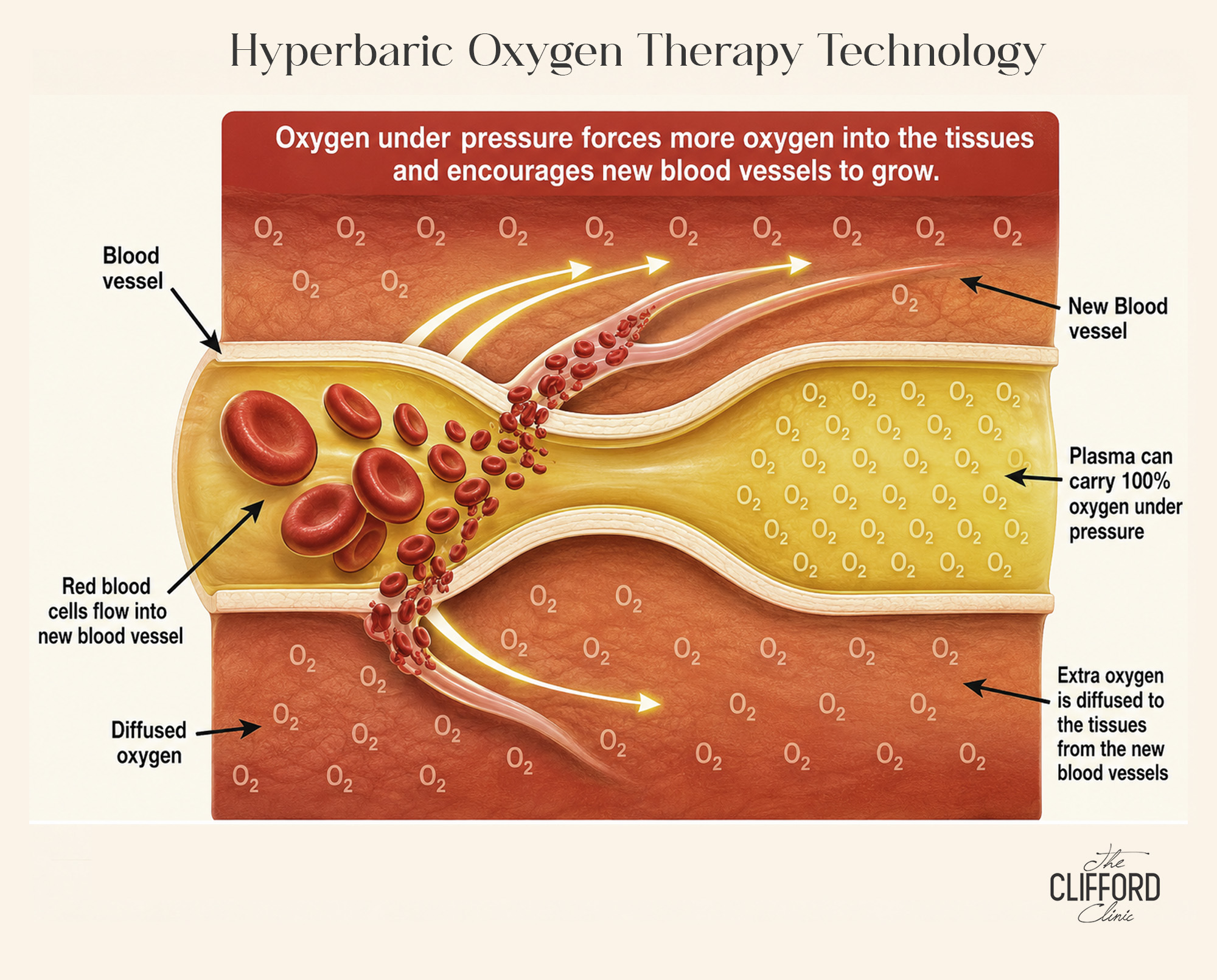
A session has three phases:
- Over 5 to 10 minutes, the chamber pressure rises. You feel fullness in the ears, similar to a flight, relieved by equalising.
- Treatment under pressure. For 60 or 90 minutes, you breathe oxygen while you relax, watch a screen, listen to music or sleep.
- Pressure slowly returns to normal over several minutes, and you can resume all normal activities immediately.
There is no pain, no needle and no medication. Most patients describe HBOT treatment as one of the most restful parts of their week.
How an HBOT Course Is Structured
Because HBOT works cumulatively, it is delivered as a structured course. Typical lengths:
- Wellness and energy: 5 to 10 sessions
- Skin and anti-ageing: 10 to 20 sessions
- Sports recovery and injury: 5 to 15 sessions
- Recovery and longevity protocols: 20 to 60 sessions
Sessions are usually scheduled either several times per week or once a week. Choosing between 60-minute and 90-minute sessions depends on your goal, and the difference is reflected in our hyperbaric oxygen cost guide.
What the Research Shows About Results
What can you realistically expect? Published trials give concrete answers for specific goals.
For athletic recovery, the 2019 randomised controlled trial by Chen and colleagues, published in BioMed Research International, did a study whereby forty-one athletes with exercise-related muscular injuries were randomised to either HBOT or a placebo treatment, with each group receiving 10 sessions. By the end of the tenth session, the HBOT group showed prominent reductions in creatine phosphokinase, a blood marker of muscle damage, alongside reductions in pain.
For tissue healing, a 2018 study in Scientific Reports by Oyaizu and colleagues, using a muscle injury model, found that HBOT both reduced early inflammation and accelerated the activation of satellite cells, the cells responsible for regenerating muscle fibres. The researchers described HBOT as having “a dual role in decreasing inflammation and accelerating myogenesis.”
For cognition, the 2020 randomised controlled trial by Hadanny and colleagues in the journal Ageing found measurable improvements in healthy older adults after a course of treatment. To see how strong the evidence is across different goals, read our evidence review and our guide to the benefits of hyperbaric oxygen therapy.
How to Get the Most From Your HBOT Course
A hyperbaric oxygen course works best when the rest of your routine supports it. Sleep matters because much of the body’s repair happens overnight. Hydration matters because well-hydrated tissue responds better. Smoking works directly against HBOT, since it constricts blood vessels and reduces oxygen delivery.
Attendance is the single biggest predictor of results. Because effects build session by session, a course completed steadily over a few weeks outperforms the same number of sessions scattered over months. Booking sessions in advance and treating them as fixed appointments is the simplest way to protect your outcome.
Combining HBOT With Other Treatments
Hyperbaric oxygen therapy is rarely used alone. Before and after surgery, it can support tissue recovery. Alongside sports rehabilitation, it speeds the return to training. Within a longevity programme, it complements screening, nutrition and lifestyle work. This is why HBOT is best delivered in a clinic that also offers wider care. At The Clifford Clinic, a course can be coordinated with longevity and wellness services and with dermatology expertise reflected across the wider network at drgerardee.com.
Is HBOT Treatment Safe?
HBOT is among the safest therapies in modern medicine when properly screened and supervised. The most common side effect is mild ear discomfort. Our full guide to HBOT side effects and safety covers the details, and our overview of who HBOT is for explains candidacy.
What Research Suggests About Session Frequency
A common question is how often sessions should be scheduled. The research offers useful guidance. The 2010 Cell Stress and Chaperones study by Godman and colleagues found that the formation of new vascular structures in human cells was particularly pronounced after two daily hyperbaric treatments, which suggests that closely spaced sessions help the angiogenic response build momentum.
Clinical trial protocols reflect this. The 2020 cognitive enhancement trial by Hadanny and colleagues in the journal Ageing delivered sessions five days per week. The 2019 athlete recovery trial by Chen and colleagues used a compact block of 10 sessions. Across the literature, the pattern is consistent: HBOT is delivered in concentrated courses, not scattered single visits.
For patients, the practical takeaway is simple. A course completed steadily, several times a week, gives the cumulative biology its best chance. An interrupted course, stretched thin over months, works against the very mechanisms that make HBOT effective. This is why scheduling and attendance are not administrative details; they are part of the treatment itself.
Tracking Progress Through a Course
A well-run HBOT course is measured, not guessed at. Because the benefits of treatment build gradually, the only way to know whether a protocol is working is to assess progress at intervals. For a wound, that means measuring size and tissue quality. For recovery, it means tracking pain, function and the markers the 2019 Chen trial used, such as creatine phosphokinase. For cognitive goals, it means a structured assessment of memory and attention, the approach taken in the 2020 Hadanny trial in the journal Ageing.
This matters for you as a patient. A clinic that reviews your progress mid-course can adjust the protocol, extend it, or have an honest conversation about stopping. Treatment without measurement is just attendance. Our guide on whether HBOT works explains why objective assessment is central to good hyperbaric care.
Frequently Asked Questions
How long does HBOT treatment take?
Each session is 60 or 90 minutes. Total in-clinic time is slightly longer once briefing, pressurisation and decompression are included.
How many HBOT treatments will I need?
Between 5 and 60, depending on your goal. Research protocols range from 10 sessions for athletic recovery to 60 for cognitive enhancement.
When will I see results from HBOT?
It depends on the goal. In the Chen 2019 athlete trial, measurable changes appeared by the tenth session. Deeper effects such as angiogenesis build over a longer course.
Can I drive or work after an HBOT session?
Yes. There is no downtime. Some patients feel mildly tired in the first few sessions, which settles as the body adapts.
Key Research References
- Thom SR. Oxidative stress is fundamental to hyperbaric oxygen therapy. Journal of Applied Physiology, 2009.
- Godman CA et al. Hyperbaric oxygen induces a cytoprotective and angiogenic response in human microvascular endothelial cells. Cell Stress and Chaperones, 2010.
- Chen CY et al. Early Recovery of Exercise-Related Muscular Injury by HBOT. BioMed Research International, 2019.
- Oyaizu T et al. Hyperbaric oxygen reduces inflammation, oxygenates injured muscle, and regenerates skeletal muscle via macrophage and satellite cell activation. Scientific Reports, 2018.
- Hadanny A et al. Cognitive enhancement of healthy older adults using hyperbaric oxygen: a randomised controlled trial. Aging, 2020.
- Heyboer M et al. Hyperbaric Oxygen Therapy: Side Effects Defined and Quantified. Advances in Wound Care, 2017.
To plan an HBOT course around your goals, book a consultation at The Clifford Clinic.