

Acne Scar Treatment Using Subcision, Rejuran, and Biostimulator Fillers Like Radiesse or Ellanse
If acne scars are still showing up in photos even when your acne is under control, you are not alone. Depressed acne scars change how light hits your face, so the texture can look more obvious under bright daylight, office lighting and with our smart phone cameras. Many patients tell me the same thing, their skin looks fine in one mirror, then looks uneven in another mirror and looks even more uneven in photos.
That is why I do not treat acne scars with a single method. Every scar is different and every patient and individual is different. I treat acne scars by understanding how each patient is different with different skin types, different skin thickness, different volume loss in the temples and the cheeks and different skin colour.
In a TODAY online feature article, actor and host Mark Lee shared that his complexion improved after he underwent skincare treatments at The Clifford Clinic and that friends and relatives even asked if he had cosmetic surgery. The article also states that he turned to the clinic’s acne scar treatment programme and has been following up for maintenance treatments.

That story resonates with many of my patients, because the goal is not to look different. The goal is to look like yourself on your best day, with smoother textures and less shadowing from scars.
If you are searching for a high impact, dermatology led approach, this is where a layered protocol can make a real difference: acne scar treatment using subcision, paired with Rejuran and supported with a biostimulator filler such as Radiesse or Ellansé.
This is the approach I use when the scars are tethered and the skin has a loss of collagen and fats.
Why acne scars keep looking uneven even after acne clears
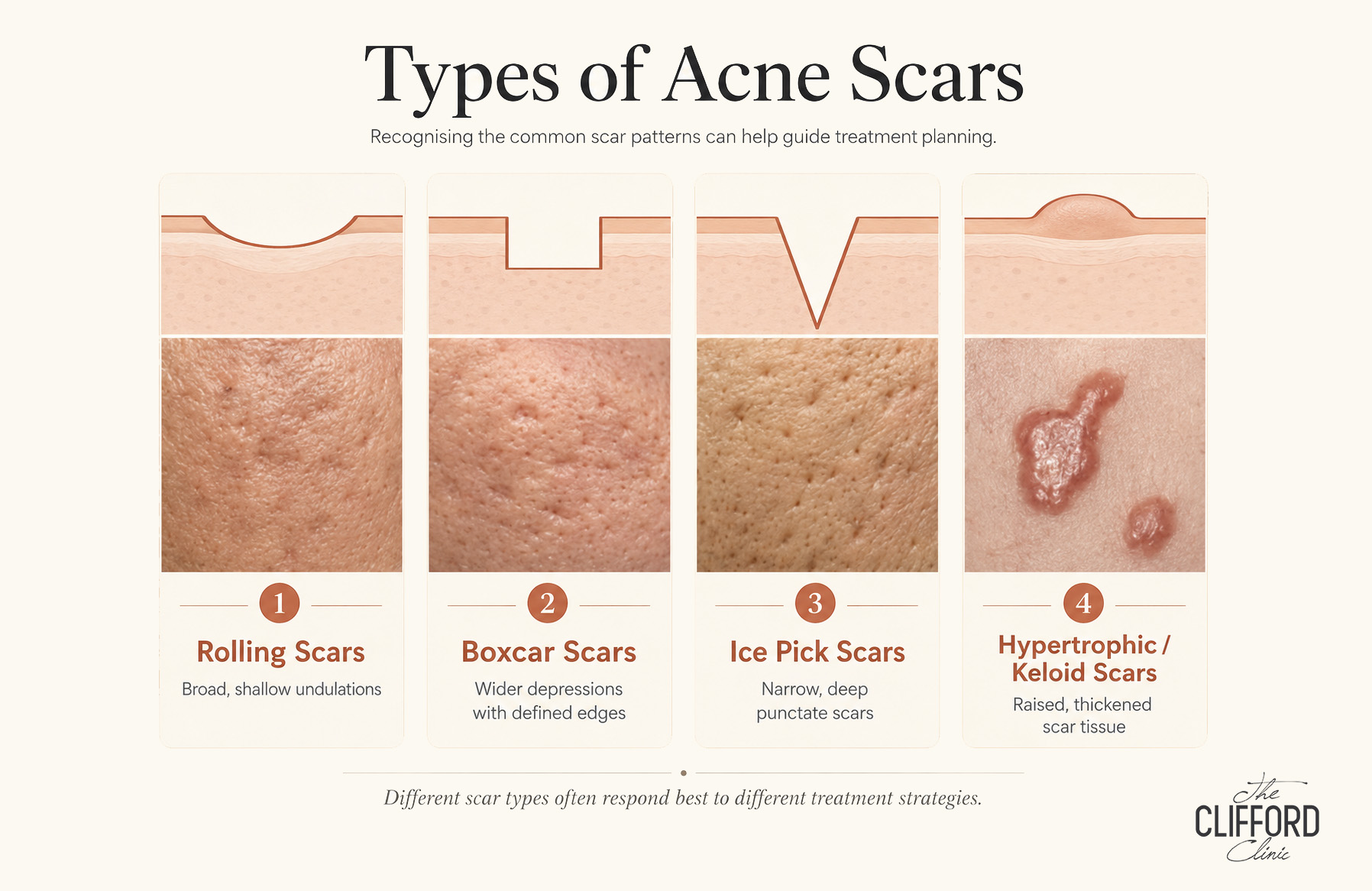
Most of the facial acne scars that people want to treat are atrophic scars with a combination of rolling, boxscar and ice-pick scars. The depression is not only a superficial issue that is limited to the superficial dermis. It is often a structural issue that involves damaged collagen in the dermis and in many cases there are fibrous bands beneath the scar that pull the skin downward.
In the TODAY feature, Dr Gerard Ee explained that recurrent pustular acne in the same spots can cause depression in the skin to form as the collagen structures in the dermis become permanently damaged. These undulations resemble rolling hills, which is why they are called rolling acne scars.
This is why topical creams and only some prescription ones can stimulate collagen, it cannot help to elevate acne scars that are compounded by volume loss. When the problem is tethering and dermal architecture, the solution needs to reach the dermis and the scar base.
The three part strategy that makes stubborn scars respond
When I design a plan for acne scar treatment using subcision, I think in three steps.
- First, release what is pulling the scar down.
- Second, improve the healing environment so collagen can remodel more effectively.
- Third, provide support and biostimulation so the released scar has the best chance to lift and stay lifted as collagen rebuilds.
That is where subcision, Rejuran, and biostimulator fillers work together.
This is also why patients who have tried multiple lasers elsewhere sometimes feel stuck. Lasers can be excellent for surface refinement and edges, but a tethered scar often needs mechanical release first. Reviews of atrophic acne scar treatments describe subcision as a commonly used method for atrophic scars and highlight the value of combining subcision with other modalities for better outcomes.
Step one: Subcision for rolling acne scars
Subcision, is a minimally invasive technique used to treat certain depressed acne scars, especially rolling scars. The goal is to release fibrous bands that tether the scar to deeper tissue, which allows the skin surface to lift and stimulates a remodeling response.
A comprehensive review in the medical literature describes subcision as commonly indicated for atrophic acne scars and discusses treatments and combination approaches used to maximize results.
On our clinic site, we also explain subcision for acne scars as a minor in office procedure designed to release acne scars from underlying tissues by breaking the fibrous bands that tether the skin down.
Why subcision is often the turning point for patients
A tethered scar is not just a shallow dent. It is a dent that is held down. When you release that attachment, you are addressing the root mechanics behind why the scar stays depressed.
This is the reason acne scar treatment using subcision can produce an improvement that feels different from surface only treatments. Patients often describe that their scars start to reflect light more evenly, makeup sits better and skin looks smoother on expression not just in still photos.
A narrative review of atrophic post acne scar treatment reports significant and persistent improvement when subcision is combined in a protocol that includes filler and later fractional laser and it notes that combining subcision with other modalities can provide more noticeable clinical improvement than subcision alone.
Who benefits most from subcision
Subcision is most suited for rolling scars and for scars that show a clear tethering pattern. If you smile and certain scars deepen dramatically or if you stretch the skin and see the scar flatten temporarily, those can be signs that tethering is contributing.
Subcision is not always the only answer. Ice pick scars and sharply edged boxcar scars often need additional targeted techniques. That is why a proper scar mapping consultation matters.
Step two: Rejuran and polynucleotides to support collagen remodeling
Once tethered scars are released, the next question is how to guide the healing process so collagen rebuilds in a more organized way. This is where Rejuran for acne scars is commonly considered as part of a layered plan.
Rejuran is widely known in aesthetic medicine as a polynucleotide injectable used to improve skin quality and support regenerative processes. A 2024 peer reviewed review of polynucleotides in aesthetic medicine describes how polynucleotides have been used for skin texture improvement and other aesthetic outcomes, while also noting variability across studies.
Most importantly for acne scar patients, there is clinical research specifically evaluating highly purified polynucleotides in atrophic acne scars. A prospective randomized study reported that polynucleotides in monotherapy were safe and more effective than placebo for atrophic acne scars, while also calling for larger studies and longer follow up.
Why I like Rejuran S as a partner after subcision
Subcision does the release. Rejuran supports the quality of the remodeling environment. When you combine a mechanical correction with regenerative support, you are not only lifting a scar, you are improving how the dermis repairs.
Patients often choose Rejuran because they want improvement that looks natural. They want smoother texture and healthier looking skin, not an overfilled appearance.
This also aligns with what many public facing professionals want. In the TODAY feature, Mark Lee described how he used thick foundation and powder to cover scars during filming, which sometimes worsened his skin when residual makeup was not fully removed. After treatments, he noticed his skin felt smoother when washing his face.
Step three: Biostimulator fillers that rebuild support and stimulate collagen
After a scar is released, the treated plane can benefit from structural support while collagen remodels. This is where a biostimulator filler can be a valuable part of acne scar treatment using subcision.
Two biostimulator options that are commonly discussed are Radiesse and Ellanse.
Radiesse for collagen stimulation and structural support
Radiesse is a calcium hydroxylapatite injectable implant. The United States FDA labeling states that Radiesse is indicated for subdermal implantation for the correction of moderate to severe facial wrinkles and folds such as nasolabial folds, and it is also intended for restoration or correction of facial fat loss in people with HIV.
In scar focused work, many clinicians discuss the concept of using calcium hydroxylapatite as a biostimulatory agent. A published consensus paper on hyperdiluted calcium hydroxylapatite provides guidance on use and notes that Radiesse diluted in certain ways can improve acne scars with minimal volume gain.
What this means for a patient is simple. The goal is not to puff the skin up. The goal is to support collagen rebuilding so the skin surface becomes smoother and reflects light more evenly.
Ellanse for collagen stimulation with long term planning
Ellanse is a poly epsilon caprolactone based dermal filler. The Ellanse official site states the EU approved intended use is subdermal implantation in the face for the lasting correction of wrinkles and facial aging signs or conditions.
The Ellanse Summary of Safety and Clinical Performance describes the device and its clinical performance information as part of transparency documentation.
For acne scar treatment, the reason clinicians pay attention to polycaprolactone fillers is collagen stimulation. A pilot investigative study reported that radiofrequency assisted subcision combined with polycaprolactone based dermal fillers can be an effective intervention in managing post acne scars, while recommending larger randomized trials for more precise conclusions.
Choosing between Radiesse and Ellansé
Both are biostimulators, but they are not the same product and they are not interchangeable. The right choice depends on scar pattern, skin thickness, degree of volume loss, and the overall plan.
In my practice, the decision is guided by three priorities.
First, what does your scar actually need, release, regeneration, support, or all three.
Second, what outcome do you want, subtle texture refinement, structural lift, or a combination.
Third, what is the safest and most predictable path for your face, using products and techniques that match your anatomy and risk profile.
If you have been searching for subscision, Radiasse, Ellanse, and Rejuran all in one plan, the real value is not simply doing everything at once. The real value is selecting the right layers in the right order.
What makes acne scar treatment using subcision more convincing than surface only treatment plans
Many patients come in after trying lasers or microneedling packages. They often improved slightly, but certain dents remain.
The reason is scar mechanics.
Surface energy devices can improve texture and edges. They can remodel collagen in the dermis. But if the scar is tethered, the anchor needs to be released. That is why subcision is often essential for rolling scars.
Once released, Rejuran can support skin quality and remodeling.
Then, a biostimulator filler can provide support and collagen stimulation so the scar plane remains elevated while collagen rebuilds.
The medical literature consistently supports combination thinking. Reviews of subcision and post acne scar treatments highlight that combining subcision with other approaches can improve outcomes compared with a single method alone.
My approach to planning your scar journey
When someone comes in for acne scar treatment using subcision, I do not guess. I map.
I evaluate scar types, including rolling scars, boxcar scars, and ice pick scars.
I assess tethering, skin thickness, and how scars change with facial movement.
I then design a staged plan that matches scar mechanics.
A typical plan may include the following phases, depending on your scars and goals.
- Consultation and scar mapping, including photography and a clear discussion of priorities.
- Subcision sessions to release tethered rolling scars.
- Rejuran sessions to support skin quality, collagen remodeling, and overall dermal health.
- Biostimulator filler support with Radiesse or Ellansé when indicated to reinforce structure and stimulate collagen.
- Optional resurfacing to refine edges, pores, and residual texture, especially for mixed scar types.
The TODAY feature itself emphasises combination treatment planning and describes that the acne scar programme at The Clifford Clinic uses a combination of treatments to stimulate collagen fibers that help pad out depressions caused by acne scarring.
On our clinic site, we also explain that subcision is excellent for releasing tethered bands in rolling acne scars and that injectables can help strengthen the dermis and provide structural support where volume loss keeps scars depressed.
What results can look like when the plan is done properly
The most meaningful improvements are often not a single dramatic moment. They are because of years of collagen growth over a period of time.
Patients often tell me they start to feel more confident at closer distances, in brighter rooms, and on video calls, because the shadows from scars soften.
Mark Lee described that his discomfort during a maintenance procedure was minimal with numbing cream, and that he could see a difference within days and noticed smoother skin when washing his face.
Every face is different, and outcomes depend on scar type, scar depth, and how your skin heals. What I can promise is this: the plan is not random. It is built around scar mechanics, regenerative support, and structured follow-up.
Why do patients trust me with their acne scars
Acne scar treatment requires both medical judgement and aesthetic restraint. If you chase scars aggressively without a plan, you can create prolonged downtime, pigmentation issues, or uneven healing. If you treat too lightly, you waste time and money.
Patients choose me because I focus on three things.
First, correct diagnosis of scar type and tethering.
Second, a combination strategy, so we treat the cause, not only the surface.
Third, natural-looking improvement, because the goal is smoother skin that still looks like you.
For patients who want to understand my training and background, my professional biography lists qualifications including MBBS, MRCS, and a postgraduate dermatology diploma from Cardiff.
Ready to start your acne scar plan
If you have been searching for acne scar treatment using subcision, and you want to combine subscision release with Rejuran regeneration and a biostimulator filler like Radiesse or Ellanse, the next step is a proper scar assessment.
FAQ for patients searching for subscision, Rejuran, Radiesse, and Ellansé
Can Rejuran improve acne scars
Polynucleotide treatments have published evidence supporting improvement in atrophic acne scars compared with placebo in a randomized study, and reviews describe polynucleotides as used for skin quality and regenerative aims in aesthetic medicine.
Does Radiesse work for acne scars
Radiesse is FDA-approved for certain indications such as facial wrinkles and folds and facial lipoatrophy in HIV. Clinicians also discuss calcium hydroxylapatite as a biostimulatory agent, and a published consensus notes experience using diluted Radiesse for acne scar improvement with minimal volume gain.
What about Ellanse for scars
Ellanse is described as a poly epsilon caprolactone-based dermal filler with EU approved intended use for facial correction of wrinkles and aging signs. A pilot study reported effectiveness when polycaprolactone-based filler was combined with radiofrequency assisted subcision for post acne scars, while recommending larger trials.
How many sessions will I need?
This depends on scar type, scar depth, and how mixed the scar patterns are. Rolling scars often need subcision focused work, and other scar types may need additional targeted methods. A consultation and scar mapping session gives the most accurate plan.
What is the difference between Radiesse and Ellanse
Both these biostimulator fillers have different viscosity and G Prime. Its used or different areas of the face that require different types of viscosity of fillers. Its an art knowing which type of filler suits which area best.
References
- Vempati A, Zhou A, Braunberger TL, et al. Subcision for atrophic acne scarring: a comprehensive review of surgical instruments and combinatorial treatments. 2023.
- Attia E, et al. Atrophic postacne scar treatment: narrative review. JMIR Dermatology. 2024.
- Araco A, Araco F. Preliminary prospective and randomized study of highly purified polynucleotide versus placebo in treatment of moderate to severe acne scars. Aesthetic Surgery Journal. 2021.
- Lee KWA, et al. Polynucleotides in aesthetic medicine: a review of current practices and perceived effectiveness. 2024.
- de Almeida AT, et al. Consensus recommendations for the use of hyperdiluted calcium hydroxylapatite as a face and body biostimulatory agent. 2019.
- Lotfi E, et al. Radiofrequency assisted subcision combined with polycaprolactone based dermal fillers in the management of atrophic facial acne scars: a pilot investigative study. 2022.

Author Bio
Dr Gerard Ee

Dr Gerard Ee is the Medical Director of The Clifford Clinic in Singapore. He earned his medical degree from St George's University of London and built his surgical experience across the Singapore General Hospital, National University Hospital, and Mount Sinai Hospital in New York. He holds Membership of the Royal College of Surgeons (Edinburgh) and a Postgraduate Diploma in Dermatology (Cardiff), and is fully accredited in aesthetic procedures including botulinum toxin, fillers, lasers, and light therapies. A strong advocate of minimally invasive, natural-looking results, Dr Ee has published in several medical and scientific journals and presented his research in cities including Taipei, Las Vegas, and London.
See all posts by Dr Gerard Ee »