
What 100% Gets Rid of Acne? A Doctor’s Honest Guide (Singapore, 2026)
What 100% Gets Rid of Acne? A Doctor Honest Guide
The honest hook
If you’re looking for real, lasting control of acne, the most reliable approach is doctor-led treatment that matched to your acne type and for many patients, that includes AviClear (to reduce sebaceous activity across wider areas) and Agnes RF (to precisely treat recurrent “same-spot” cysts and nodules). Used together within a medical plan, they can clear skin fully and reduce future flares far beyond what skincare alone can do.
In our Singapore clinic, we do this every day by matching treatment to acne type, skin type, and your goals, then staying practical about relapse prevention.
This guide answers the search you probably typed and we are here to provide you with a straight, patient-first plan you can use to decide your next step.
Quick summary (so you know where this is going)
- Most patients clear with evidence-based combinations: topical retinoid + benzoyl peroxide (BPO) ± short oral antibiotics, or hormonal therapy for female-pattern acne; isotretinoin for nodulocystic/scarring acne such as (AviClear, Acne Lasers, Agnes) as needed.
- Ultrasound-guided treatments for recurrent lesions, along with intralesional injections, provide faster relief.
- Maintenance: usually a gentle retinoid routine to prevent relapse and PIH.
- The earlier we treat, the lower the risk of scars and the faster you get your life back.

First principles: what does “clear” really mean?
We don’t define “clear” as one good week. We define clinical clearance as:
- No inflammatory lesions (papules/pustules/nodules) for 8–12 consecutive weeks
- Comedones reduced to a level that doesn’t bother you or trigger new flares
- Patient-reported improvements in oiliness, comfort, and post-inflammatory hyperpigmentation (PIH)
- Photo documentation that shows stable results
Step 1: Name your acne type (it drives treatment)
Acne isn’t one disease; it’s a family of phenotypes. In Singapore, we commonly see:
- Comedonal-predominant acne : blackheads/whiteheads, minimal redness.
- Inflammatory papulo-pustular acne : red bumps and “white-heads” that are actually pustules.
- Nodulocystic acne : large, deep, painful lumps; high scarring risk.
- Adult-female (hormonal-pattern) acne : jawline/neck flares, pre-menses worsening, resistant to typical routines.
- Acne with PIH/PIE : in skin phototypes III–VI, redness (PIE) and brown marks (PIH) often outlast the pimple.

Step 2: The evidence-based treatment hierarchy (what actually works)
A) Foundation therapy (most cases start here)
Topical retinoid at night (adapalene or tretinoin)
- Normalises keratinisation → prevents micro-comedones (the “seed” of acne).
- Start 3–4 nights/week, pea-sized amount; moisturiser sandwich if sensitive.
Benzoyl Peroxide (BPO) (wash or leave-on)
- Directly lowers C. acnes counts; crucial when any inflammation is present.
- Use 2.5–5% to reduce irritation and always protect fabrics (it can bleach).
Add a topical antibiotic only in a fixed combination with BPO
- Clindamycin/BPO or adapalene/BPO combos are preferred to limit resistance.
- Avoid antibiotic monotherapy and long durations.
Timelines: Comedones usually improve in 6–8 weeks; inflammatory lesions in 8–12 weeks. If you hit a plateau, escalate.
B) Oral antibiotics (short bridge, never solo)
For moderate inflammatory acne, a 6–12 week course of doxycycline or minocycline can help and it is always paired with BPO and a retinoid. We avoid long courses to reduce antimicrobial resistance, and we plan a step-down to maintenance once control is achieved.
C) Hormonal therapy (adult-female pattern)
If acne tracks your cycle (jawline, neck, pre-menses flares) or there are signs of androgen excess, we discuss hormonal options:
- Combined oral contraceptives (selected types) if suitable;
- Spironolactone (often 25–100 mg/day). We monitor blood pressure and potassium, and ensure contraception (it’s anti-androgenic).
PCOS red flags we don’t ignore: irregular periods, hirsutism, central weight gain, acanthosis nigricans, or sudden severe acne. Work-up may include an androgen panel and referral to gynae/endocrinology as needed.
Expectations: Gradual improvement across 8–12 weeks, then consolidation over months. Many women find this pathway gentler than repeated antibiotics.

D) Isotretinoin (the disease-modifying option)
When acne is nodulocystic, scarring, relapsing, or significantly affecting mental health and work/school life, oral isotretinoin should be on the table early.
- How it works: shrinks sebaceous glands, normalises keratinisation, reduces inflammation—attacking all key drivers of acne.
- Dosing: daily low-to-standard with a goal cumulative dose ~120–150 mg/kg (lower targets are possible with more maintenance but have higher relapse).
- Monitoring: baseline and periodic LFT/lipids, pregnancy prevention and testing (it’s teratogenic), side-effect counselling (dryness, photosensitivity).
- Outcomes: Many patients achieve clearance by month 3–5. Long-term remission rates are the best of any therapy; relapse 10–30% at 1–2 years depending on dose, phenotype, and maintenance.
Bottom line: If you’re the patient still flaring despite “everything,” isotretinoin is often the most reliable path to clear.
E) Procedures and devices (precise roles, not hype)
RF-assisted comedone opening / professional extractions
- For stubborn closed comedones, a quick RF nick can ease removal with less trauma. Good as an adjunct to retinoids.
Intralesional steroid injections
- For a painful cyst/nodule, a tiny steroid injection reduces inflammation within 24–48 hours and can prevent scarring.
AviClear (1726 nm) — device-based acne reduction
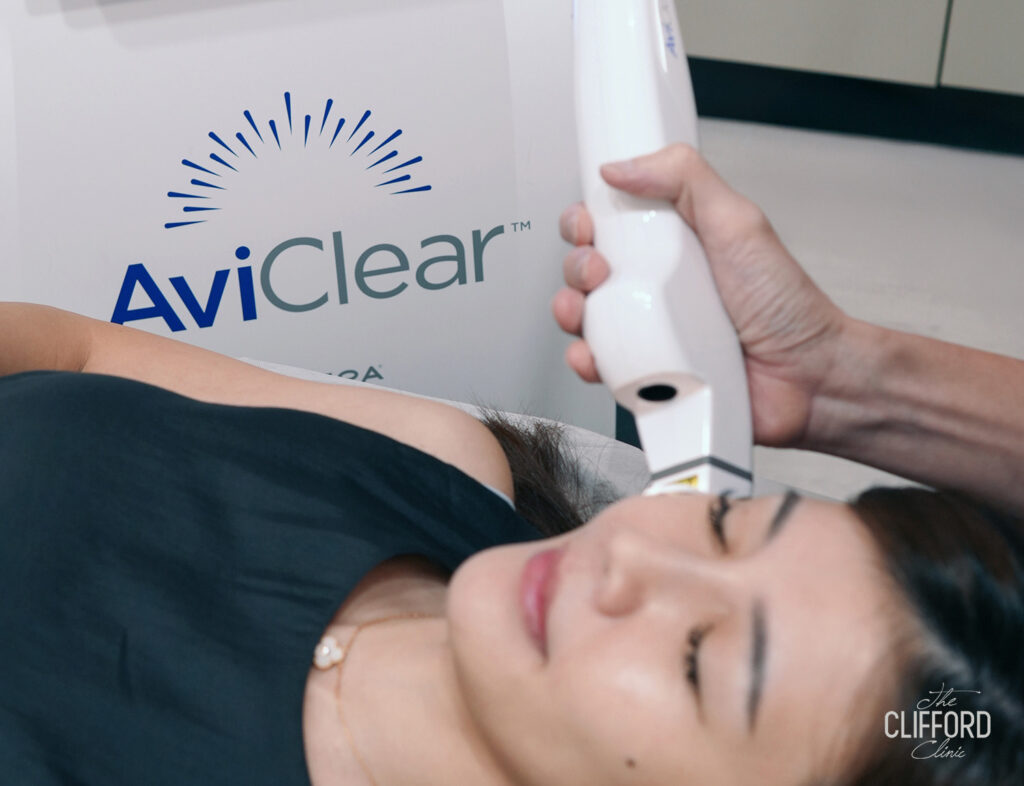
- AviClear targets the skin’s oil glands to reduce breakouts at their source. Using a 1726-nm wavelength, it selectively absorbs in sebum and heats the sebaceous glands just enough to dial down oil production without damaging the surface skin. In practical terms, that means fewer new pimples and a steadier complexion over time, especially for patients with sebaceous-driven acne who prefer to avoid or can’t tolerate medications.
- A series of 3 sessions (about a month apart). Best for sebaceous-driven acne in patients who avoid or cannot tolerate medications.
- Expect gradual reduction in oil and lesion counts over 3–6 months; many still use a light topical routine. It’s not a miracle switch, but it can be a game-changer in the right hands.
- Agnes is a targeted radiofrequency (RF) treatment for stubborn, recurrent acne that works by precisely heating and shrinking overactive sebaceous glands—the source of many “same-spot” pimples and cysts.
- Using a fine, insulated microneedle under local anaesthesia, the doctor delivers RF energy only to the gland while sparing surrounding skin, reducing oil output and the likelihood of repeat flare-ups in that area.
- It’s especially useful for nodules, cysts, and persistent lesions along the jawline or T-zone that keep returning despite topicals or antibiotics. Downtime is typically mild (temporary redness, tiny entry points), and results evolve over weeks as the gland settles; many patients pair Agnes with a medical acne plan to control general breakouts and prevent post-inflammatory marks.
- The Q-Switch laser is a non-invasive treatment that delivers ultra-short, high-energy pulses to break up unwanted pigment while leaving surrounding skin largely unaffected.
- At The Clifford Clinic, we use Q-Switch (commonly 1064/532 nm) to address freckles, sun spots, post-inflammatory hyperpigmentation, and uneven tone, and to refine pores and overall skin clarity with minimal downtime.
- The rapid, photoacoustic pulses shatter pigment into tiny particles that the body gradually clears, making it suitable for a range of skin types when parameters are carefully adjusted. Most patients describe a brief “snap” sensation and mild, transient redness; sessions are quick, and results build over several visits alongside diligent sun protection and pigment-safe skincare.
Step 2: The evidence-based treatment hierarchy (what actually works)
A) Foundation therapy (most cases start here)
Topical retinoid at night (adapalene or tretinoin)
- Normalises keratinisation → prevents micro-comedones (the “seed” of acne).
- Start 3–4 nights/week, pea-sized amount; moisturiser sandwich if sensitive.
Benzoyl Peroxide (BPO) (wash or leave-on)
- Directly lowers C. acnes counts; crucial when any inflammation is present.
- Use 2.5–5% to reduce irritation and always protect fabrics (it can bleach).
Add a topical antibiotic only in a fixed combination with BPO
- Clindamycin/BPO or adapalene/BPO combos are preferred to limit resistance.
- Avoid antibiotic monotherapy and long durations.
Timelines: Comedones usually improve in 6–8 weeks; inflammatory lesions in 8–12 weeks. If you hit a plateau, escalate.
B) Oral antibiotics (short bridge, never solo)
For moderate inflammatory acne, a 6–12 week course of doxycycline or minocycline can help—always with BPO and a retinoid. We avoid long courses to reduce antimicrobial resistance, and we plan a step-down to maintenance once control is achieved.
Step 3: Set success targets (so you can measure progress)
Comedonal acne: 6–8 weeks to see smoothness, blackheads loosen, and fewer micro-bumps.
Inflammatory papulo-pustular acne: 8–12 weeks to “quiet,” fewer new lesions, less tenderness.
Nodulocystic acne: with isotretinoin, steady gains from week 4–8, often clear by month 3–5.
Devices (AviClear/Agnes): progressive improvements over 3–6 months after the series.
If you’re not seeing movement by these checkpoints, escalate. The costliest mistake is staying on a non-working plan long enough to scar.
What actually “prevents” acne from coming back?
No one can guarantee zero pimples ever again. But we dramatically lower relapse by:
- Keeping a retinoid in your routine (nightly or 3–5 nights/week).
- Using BPO in breakout-prone zones a few times a week.
- Hormone control when appropriate (spironolactone/OCP).
- A rescue protocol: if you flare, you know exactly what to do for 4–8 weeks (not guesswork).
- Fixing friction/occlusion triggers: helmets, collars, sweaty masks, heavy hair pomades at the hairline.
- Considering diet tweaks: lower-GI style eating; reduce skim milk/whey if you notice flares; prioritise whole foods.

Singapore-specific realities (so you’re not surprised)
- Claimability: Acne care is usually outpatient self-pay. Some corporate/personal insurance plans may cover consultations, medications, or procedures if medically indicated; Medisave generally does not apply to outpatient acne treatments.
- Safety & compliance: We avoid superlatives and guarantees. We use phrases like “may help reduce”, “doctor-guided”, and “results vary by individual.”
- Access & monitoring: Isotretinoin requires lab monitoring and strict pregnancy prevention; spironolactone requires blood pressure/potassium checks. Devices are booked in series with pre-/post-care instructio
When to seek medical care quickly
- Deep, painful nodules/cysts, especially if they leave marks → early treatment prevents scars.
- Signs of infection (fever, spreading redness).
- Severe, sudden acne in adults (consider endocrine causes).
- Pregnancy or plans for pregnancy—some treatments are unsafe; we’ll tailor a pregnancy-safe route (azelaic, sulfur, erythromycin, gentle peels/LED).
Frequently asked questions
What really gets rid of acne fast?
- For a single painful cyst, intralesional steroid can flatten it within 24–48 hours.
- For a flare, a short course of doxycycline/minocycline plus BPO + retinoid calms within 1–2 weeks; finish the full 6–12 weeks while your topicals take over.
- For recurring cystic acne, isotretinoin is fastest to reliable clear.
Is isotretinoin the only cure?
- It’s the most disease-modifying option with the best long-term remission rate, especially for nodulocystic acne. Not everyone needs it, but if you keep relapsing or you’re scarring, it’s often the right choice.
Do facials cure acne?
- Facials can assist with debris removal and comfort, but they don’t replace retinoids, BPO, hormones, or isotretinoin. Over-aggressive extractions increase PIH in darker skin.
Can devices replace medication?
- Sometimes for the right patient. AviClear helps sebaceous-driven acne; Agnes RF helps recurrent cysts. But in widely inflamed or scarring acne, medications remain first-line.
How do I stop dark marks (PIH)?
- Treat acne early, use SPF 50 daily, add azelaic acid/niacinamide, and consider PDL for redness (PIE) after the breakouts settle. Avoid picking—it converts a 1-day blemish into a 3-month mark.
What about diet?
- Evidence supports lower-GI eating and being cautious with skim milk/whey if you notice flares. Focus on sleep, stress management, and consistent skincare; diet is a support, not a sole cure.
Conclusion
With proper diagnosis, following a doctor-led treatment plan and regimen, it is possible to stop acne from recurring.
If you want a plan mapped to your skin and lifestyle, book a doctor-led acne assessment in Singapore.
We’ll assess your acne type, and plan a customised solution using different pathways such as topical, hormones, isotretinoin, treatments, or a mix so that you are clear and keep acne away.

Author Bio
Dr Gerard Ee
Linkedin Profile
Dr Gerard Ee is the Medical Director of The Clifford Clinic in Singapore. He earned his medical degree from St George's University of London and built his surgical experience across the Singapore General Hospital, National University Hospital, and Mount Sinai Hospital in New York. He holds Membership of the Royal College of Surgeons (Edinburgh) and a Postgraduate Diploma in Dermatology (Cardiff), and is fully accredited in aesthetic procedures including botulinum toxin, fillers, lasers, and light therapies. A strong advocate of minimally invasive, natural-looking results, Dr Ee has published in several medical and scientific journals and presented his research in cities including Taipei, Las Vegas, and London.
See all posts by Dr Gerard Ee »- Using CDA and Baby Bonus for Teenage Acne and Children Acne Treatment in Singapore
- 5-FU for Keloid Scars: How It Works, Steroid Combinations and Risks
- Breastfeeding, Pregnancy and Mammograms After Breast Implants
- Breast Implant Safety and Monitoring, Rupture, Capsular Contracture and BIA-ALCL
- Breast Implant Removal, Replacement and Revision in Singapore