
5 Things a Nose Filler Can Fix, and 3 It Cannot
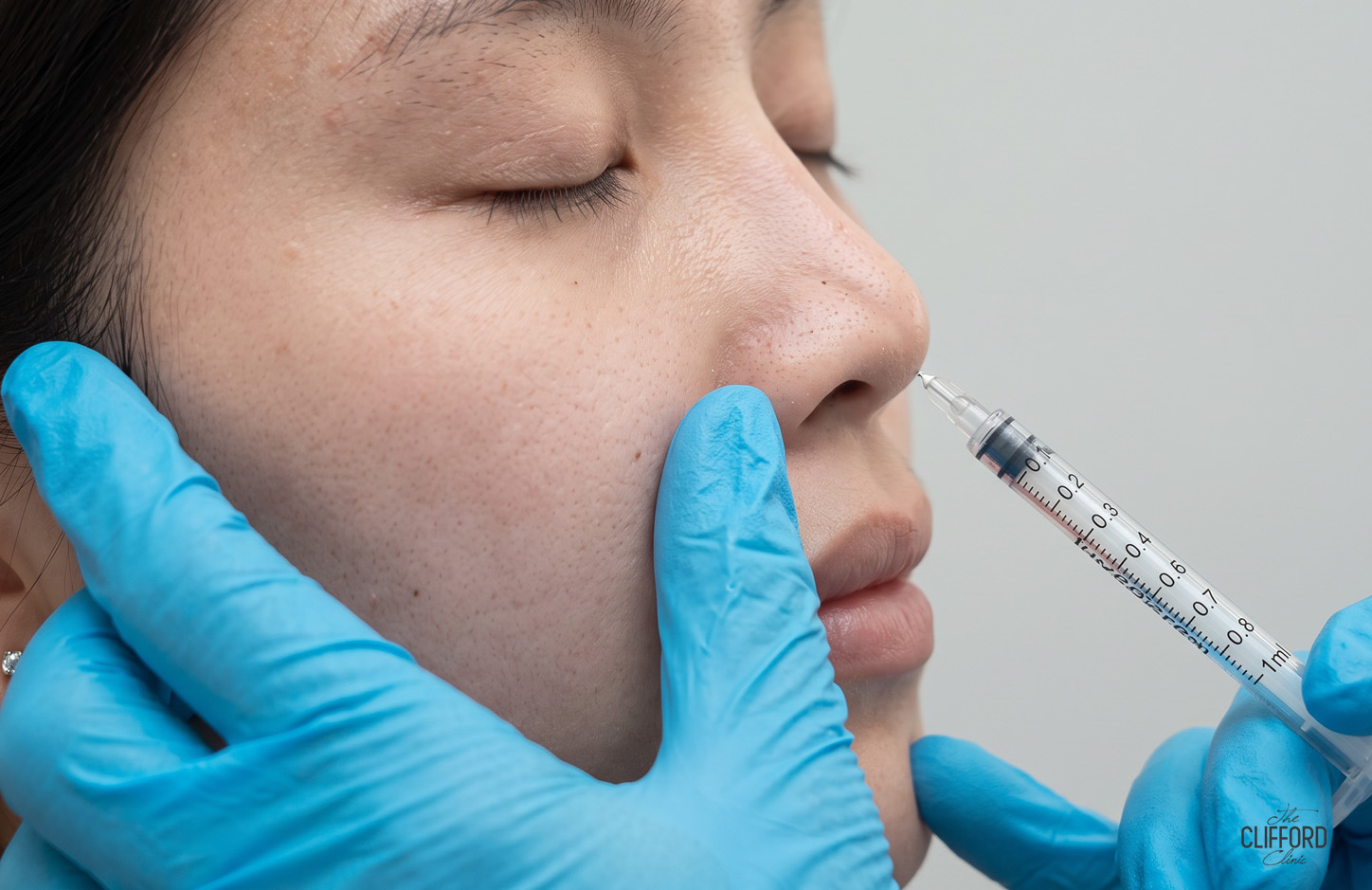
Nose filler only adds volume. That makes it useful for a low point, shallow dent or contour transition, but unsuitable for requests that require bone, cartilage or airway correction.
This article is limited to one question. What can nose filler realistically improve? The five concerns below may respond to carefully placed filler. The final three usually require another approach.
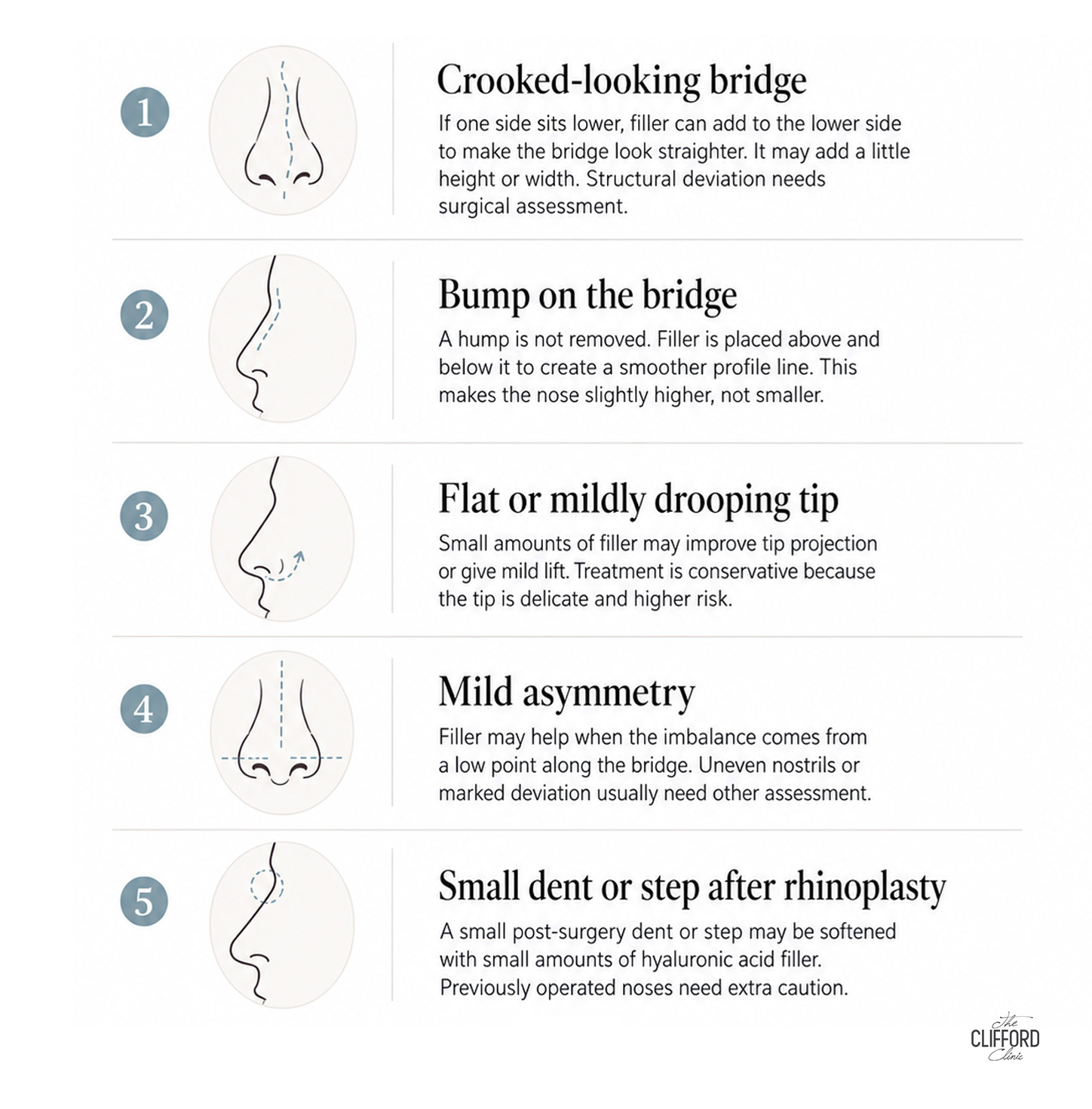
1. An Uneven or Crooked-Looking Bridge
A nose may look crooked even when the bones are fairly straight. Sometimes one side of the bridge sits a little lower, perhaps after an old injury. In other cases, a small surface irregularity catches the light and makes the centre line appear off.
The correction is made by adding to the lower side, not by reducing the higher one. Filling the dip can make the bridge look straighter, though it will also add a little height or width. A true structural deviation needs a surgical assessment.
2. A Bump on the Bridge
A dorsal hump is one of the clearest examples of what filler can and cannot do. The hump is not removed. Instead, small amounts of gel are placed above and below it so the profile reads as a smoother line from the brow to the tip.
This produces a slightly higher nose, never a smaller one. It can work well for someone who is comfortable with the size of the nose but dislikes the step visible from the side. When the aim is to lower the bridge, surgery is the relevant option.
In one clinic case, a patient in their early thirties wanted exactly this change. Restylane Lyft, a firm hyaluronic acid filler, was placed above and below the hump rather than directly over it. The profile appeared straighter at review and the patient was happy with the result. This will not suit every hump. A larger one may require more added height than the patient wants.
3. A Flat or Mildly Drooping Tip
A flat tip can make the nose look less defined. A tip that turns down may also make the profile appear heavier. In suitable noses, a very small amount of filler can improve projection or support the base enough to create a mild lifting effect.
Tip treatment is deliberately conservative. The skin is thin, the area moves with facial expression and the blood supply is dense, and complication rates are also higher than at the bridge. A bulbous tip is different from a flat tip. Adding gel to an already broad tip can make it look fuller rather than sharper.
4. Mild Asymmetry
Facial asymmetry is normal, although it often becomes more noticeable in photographs. When the imbalance comes from a low point along the bridge, a small amount of filler may bring the visual line closer to the centre.
Uneven nostrils are a different problem. Their shape is determined mainly by skin and cartilage, not by a hollow that can be filled. The same applies to a marked deviation of the nasal framework.
5. A Small Dent or Step After Rhinoplasty
A small, well-defined dent or step after rhinoplasty may be suitable for filler because the target is limited and the required volume is usually modest. In the right patient, this may avoid another operation for a minor surface irregularity.
A previously operated nose needs extra caution. Surgery changes the blood supply to the overlying skin and increases the risk of later filler injections. Our doctors use smaller amounts, usually favour reversible hyaluronic acid and may advise against treatment when the risk-benefit balance is poor.
Age-related changes are assessed differently. With age, the tip commonly drops, while the bridge itself has not necessarily lost volume. A little support at the base of the tip may therefore be more useful than adding height along the bridge.
Three Requests Nose Filler Cannot Fulfil
- It cannot make the nose physically smaller. A higher bridge may create a slimmer impression from the front, but the treatment has added volume rather than removed it.
- It cannot correct breathing. A deviated septum or blocked airway is an internal structural problem.
- It cannot reduce a bulbous tip or narrow the nostrils. These features are formed by skin and cartilage, not by a contour deficit.
How Doctors Decide Whether a Concern Is Fillable
Words such as “crooked”, “flat” or “drooping” do not identify the cause. The doctor has to decide whether the visible problem comes from a low contour that can be built up or from structure that cannot be changed by adding gel.
For Singapore pricing, filler comparisons and safety evidence, see the nose fillers in Singapore page. The nose filler FAQ page covers duration, swelling and dissolving filler.
What Can Nose Filler Fix in Your Case?
A low bridge, small hump, mild asymmetry, limited tip support or a small post-surgical dent may be worth assessing. A request for reduction, narrower nostrils or better breathing belongs in a different consultation.
Next Step After Identifying the Concern

At The Clifford Clinic, an accredited doctor assesses whether filler can create the specific change you want. The purpose is not to fit every nose into the treatment.
When gel is not the best option, the Ultra V Hiko nose thread lift may suit a nose that needs support rather than added volume. It is also useful to read the common myths surrounding nose thread lifts before deciding. Surgical rhinoplasty remains the appropriate route for reducing the nose, making a major structural change or treating a breathing problem.
For the full discussion of cost, filler types and safety evidence, read the nose fillers in Singapore guide. For the fee, clinic locations and appointment details, use the nose filler treatment page.

Written by Dr Gerard Ee, founder and medical director of The Clifford Clinic. He qualified in medicine at St George’s University of London, is a Member of the Royal College of Surgeons of Edinburgh, and holds a postgraduate diploma in dermatology from Cardiff. He trained at Singapore General Hospital, the National University Hospital and Mount Sinai Hospital in New York. He has been treating noses with filler since 2012 and holds the Aesthetic Dermatology Educational Group certificate for nose fillers, which the Singapore Medical Council accredits as a Certificate of Competence. Reviewed August 2026.

Author Bio
Dr Gerard Ee

Dr Gerard Ee is the Medical Director of The Clifford Clinic in Singapore. He earned his medical degree from St George's University of London and built his surgical experience across the Singapore General Hospital, National University Hospital, and Mount Sinai Hospital in New York. He holds Membership of the Royal College of Surgeons (Edinburgh) and a Postgraduate Diploma in Dermatology (Cardiff), and is fully accredited in aesthetic procedures including botulinum toxin, fillers, lasers, and light therapies. A strong advocate of minimally invasive, natural-looking results, Dr Ee has published in several medical and scientific journals and presented his research in cities including Taipei, Las Vegas, and London.
See all posts by Dr Gerard Ee »